🎁 0 OF 10 FREE DOWNLOADS USED (10 LEFT) Grade 2 (Ages 7–8) 🎯 CCSS Grade 2 / UK KS1 🇬🇧 UK: Year 2 (KS1) 🖨️ Tested for US Letter & A4 · Portrait
Months Of Year Order Worksheet for Grade 2
Months Of Year Order is a printable PDF worksheet for Grade 2 (Math › Time). It belongs to the Months Of Year Order set and gives children one focused page of practice they can complete with a pencil, crayons, or a marker.
✏️ Practice On-Screen ⬇ Download PDF (Free · 0 of 10 used) 🖨️ Print ✨ Create Similar with AI
Resize & download
👨🏫 Parent Teaching Guide & Interactive Answer Key
Step-by-step solutions, parent teaching script, common pitfalls, and print grading rubric for Grade 2 Months Of Year Order.
“Always start with the friendly ones column on the far right! If our ones make a two-digit number like 14, the 4 stays downstairs and the 1 takes the elevator up to the tens house!”
Subtracting the smaller top digit from the larger bottom digit without regrouping (e.g. 52 - 17 calculated as 45 instead of 35). Always ask: “Do we have enough on top?”
⏱️ 3-Minute Structured Home Teaching Plan:
Why Physical Pencil Writing Builds Stronger Neural Pathways
Preview this worksheet
✍️ Draw, Trace & Practice On-Screen
Inside this PDF
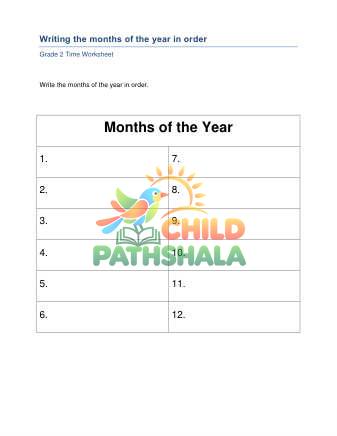
This is a 2-page pack — the thumbnail shows page 1 of 2. Words and themes pulled straight from the file include:
writingmonthsyearordergradetimeanswersjanuaryjulyfebruaryaugustmarchseptemberapril
Sample exercises from this page
- Writing the months of the year in order
- Grade 2 Time Worksheet
- Write the months of the year in order.
- Months of the Year
- 10.
- 11.
- 12.
- Answers
- Months of the Year
- 1. January
Watch: Calendar Activity Sheets in action
▶ Now playing: Calendar Activity Sheets
📺 Dedicated Watch Page →File details & curriculum alignment
Worksheet overview & learning goals
Parents searching for Grade 2 Math help often land here, and for good reason: Months Of Year Order packages Time practice from the Months Of Year Order set into a page that respects busy evenings. Print it during dinner prep, and by bedtime the practice is done — no battles, no leftover sheets.
Notice how the items climb: the first row reviews what your child already knows, the middle rows teach the actual Months Of Year Order move, and the final stretch asks them to use it independently. That arc — recall, learn, fly solo — mirrors a well-taught Grade 2 lesson in miniature.
A quiet detail worth knowing: the type on this page runs larger than standard workbook print, which reduces eye strain and letter confusion for ages 7–8 readers. Small design choices like this are why printable specialists beat generic worksheets for Grade 2 practice.
- Create a portfolio trail of dated pages that makes growth visible
- Strengthen calculation fluency with the Months Of Year Order problem set
- Support mixed-ability groups — fast finishers simply move on to sibling pages
- Improve accuracy and speed with short, focused Grade 2 practice sessions
- Strengthen attention stamina with a satisfying finish-the-page arc
- Grow confidence by mastering one Time skill before moving on
Download Full 1-Page Pack (ZIP Archive)
This page is part of the Months Of Year Order bundle, a 1-page printable pack covering Months Of Year Order for Grade 2. Single pages are perfect for tonight; the full pack is what you want for the week — download the whole bundle as one ZIP below and you will never scramble for tomorrow's practice again. You are looking at page 1 of 1 in this pack. Working the pack in order gives the smoothest progression, though every page also stands alone. Don't waste time downloading one sheet at a time — get the entire set bundled in a clean, printable ZIP archive.
Curriculum & skill alignment
This Grade 2 math printable targets Time through the Months Of Year Order skill set, giving children the repeated, focused practice that mental math fluency demands. At the Easy stage, learners benefit most from short daily sessions of ten to fifteen minutes rather than long weekly drills, because spaced repetition moves number facts from short-term memory into lasting recall. Each problem on the page isolates one thinking step so a child can self-check line by line, and parents can spot exactly where help is needed. The layout mirrors the way math is taught in Grade 2 classrooms: clear instructions at the top, generous writing space, and problems ordered from warm-up easy to stretch challenge. Used twice a week, pages like this one compound quickly — a single term of steady practice can lift a hesitant counter into a confident problem solver. Teachers often assign this sheet as morning work or a homework add-on, while parents use it for weekend catch-up before tests. Because every problem is printed in large, high-contrast type, the page also suits learners who need extra visual clarity, and the single-page format means no stapling, no lost second sheets, and no printer drama.
At the Easy band (Grade 2, ages 7–8), the developmental milestones that matter most are pencil grip, following one- and two-step directions, and sustaining focus for ten to fifteen minutes. Children this age learn through their hands, so every traced line, circled answer, and colored shape is literally wiring the brain for later academic work. Expect wobbles: letter sizes will vary, answers will drift off baselines, and attention will wander mid-page. All of that is normal and healthy. The right response is shorter sessions, warmer praise for effort, and immediate repetition of anything that clicked — this page plus one sibling variant tomorrow will do more good than any lecture about trying harder. Watch for the milestone moments: the first fully independent row, the first self-caught mistake, the first request for another page. Each one signals readiness for slightly longer, slightly harder Time work.
Step-by-step parent & teacher guide
No prep needed. Print the page in black and white or color — both work. Have the child read the instructions aloud (a tiny comprehension check in disguise), complete the first item together, then let them continue independently while you stay nearby for questions.
- Give the pencil fully to the child from item one. Even wobbly first attempts done solo teach more than perfect answers done by an adult.
- Print at 100 percent scale on Letter or A4 and keep one spare copy ready — retries happen the moment a page starts going well.
- Review and celebrate: check answers together, revisit any misses as a team, and file the page. Then pick the next variant from the bundle to lock in the months of year order skill while it is fresh.
- Model the first items: do the opening two together, thinking aloud as you go. Hearing an adult reason through months of year order work teaches the method, not just the answer.
- Narrate the thinking: ask your child to say each step out loud before writing it. Spoken reasoning catches slips before they reach the page.
Recommended supplies
Colored pencils beat markers for detail work on this page — they sharpen fine motor control and never bleed. Keep a handheld sharpener beside the practice spot; the sharpening pause doubles as a natural thinking break.
Extension activities
- Story swap: ask your child to make up a tiny story using the items or answers on the page. Nonsense is fine — the blending of Time ideas with narrative is the exercise.
- Two-day remix: reprint the same page after 48 hours and race yesterday's time — children love proving to themselves that the page got easier.
- Colour-code review: circle the easiest answer in green and the trickiest in orange, then ask why the orange one felt harder. The explanation is the real lesson hiding inside the page.
- Count and describe: have the child count objects, shapes, or answers on the page, then describe them — color, size, position. This ten-second extension turns any Math page into oral-language practice.
5 Steps to Skill Mastery for this Topic
Find exact learning gaps before practicing.
Screen-free pencil-on-paper completion.
Stuck on an item? Generate 3 mirror practice sheets.
Reinforce recall with interactive games.
Record mastery and print a diploma certificate.
Where to Go Next: 3-Tier Learning Ladder
Choose the best next step tailored to how your child performed on today’s worksheet:

Print Words A
Grade-1Rebuilds confidence with gentler foundational numbers and visual cues.
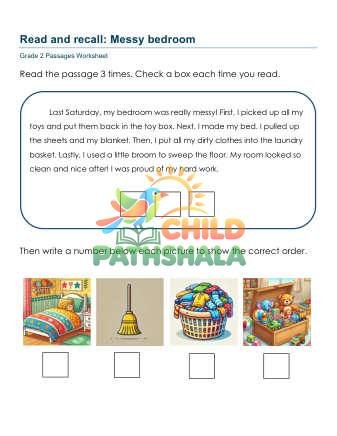
Passages Read Recall
Grade-2Parallel sibling practice to lock in muscle memory without memorization.
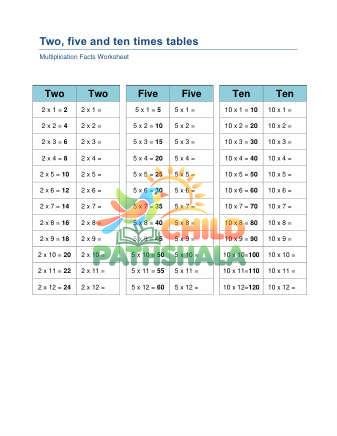
2 5 10 Times Tables A
Grade-3Advances to multi-step reasoning, higher numbers, or next grade level.
Keep practicing
Frequently asked questions
Is this time worksheet free for classroom use?
Absolutely — and that includes homeschool co-ops, tutoring centers, and after-school programs, not just traditional classrooms. There is no seat limit and no licensing paperwork for normal educational use: preview, print, and teach. The one request we make is simple — link colleagues to this page instead of emailing the file around, so everyone prints the current version. Heavy users running hundreds of copies a month should use draft mode and the bundle ZIP to keep printing budgets sane. If your school needs documentation for approved-resource lists, this page's curriculum section above describes the skill alignment in administrator-friendly language.
How do I print this PDF without dark borders or cut-off edges?
Three quick habits make classroom printing painless: test one copy before the full set, set the copier to single-sided so nothing peeks through, and keep a master folder of downloaded PDFs so you never re-search for a page you already used. For this Time sheet specifically, normal print settings are fine — the design tolerates both laser and inkjet without losing legibility.
What age group is this printable best suited for?
A quick readiness check settles it: hand the child the page and watch the first row without helping. Smooth and confident means independent practice; hesitation means work the first two items together and then step back; total stall means swap in an easier sibling variant from the same bundle this week and revisit this one after a confidence-building page. The curriculum section above lists every Months Of Year Order the page touches, so you can match it to what your class or child is covering this month rather than guessing.
What skills does this Grade 2 worksheet build?
If the first session felt smooth, extend it the following week by asking your child to predict which items will be easy before starting — metacognition like that multiplies the value of routine practice. If the session felt like a struggle, shrink the goal: cover all but one row with a sheet of paper and let the child 'unlock' rows one at a time. Either way, log the date on the finished page; dated pages from the Months Of Year Order bundle become a progress story you can actually show.
Print Months Of Year Order once and you will see why this Months Of Year Order collection stays bookmarked: one focused page, one visible win, and a bundle ready when you are. The preview above is the exact page that prints — no surprises.
Designed for Screen-Free, Real Brain Growth
Instant PDF Downloads
One-click access to thousands of high-resolution printable activity sheets.
100% Ad-Free & Safe
Zero pop-up ads or distractions — a clean, safe learning environment for kids.
Hands-On Pencil Power
Pencil-to-paper exercises that develop fine motor control and writing confidence.
Curriculum Aligned (K–6)
Crafted by educators for Preschool, Kindergarten, and Grades 1 to 6.
Active Brain Building
Logic puzzles, mazes, and math challenges that build real focus and thinking skills.
15-Minute Daily Wins
Bite-sized worksheets that give children pride and joy of completion every day.
Wait! Don't leave empty-handed 👋
Take 10% off your first bundle
Hi! 👋 Looking for a specific worksheet, grade, or learning skill? Ask me anything below! 🙂