🎁 0 OF 10 FREE DOWNLOADS USED (10 LEFT) Grade 3 (Ages 8–9) 🎯 CCSS Grade 3 / UK KS2 🇬🇧 UK: Year 3 (KS2) 🖨️ Tested for US Letter & A4 · Portrait
Money In Words Worksheet for Grade 3
Money In Words is a printable PDF worksheet for Grade 3 (Math › Money). It belongs to the Money In Words set and gives children one focused page of practice they can complete with a pencil, crayons, or a marker.
✏️ Practice On-Screen ⬇ Download PDF (Free · 0 of 10 used) 🖨️ Print ⚡ Buy All 6 Sheets ($1.00) → ✨ Create Similar with AI
Resize & download
👨🏫 Parent Teaching Guide & Interactive Answer Key
Step-by-step solutions, parent teaching script, common pitfalls, and print grading rubric for Grade 3 Money In Words C.
“Always start with the friendly ones column on the far right! If our ones make a two-digit number like 14, the 4 stays downstairs and the 1 takes the elevator up to the tens house!”
Subtracting the smaller top digit from the larger bottom digit without regrouping (e.g. 52 - 17 calculated as 45 instead of 35). Always ask: “Do we have enough on top?”
⏱️ 3-Minute Structured Home Teaching Plan:
Why Physical Pencil Writing Builds Stronger Neural Pathways
Preview this worksheet
✍️ Draw, Trace & Practice On-Screen
Inside this PDF
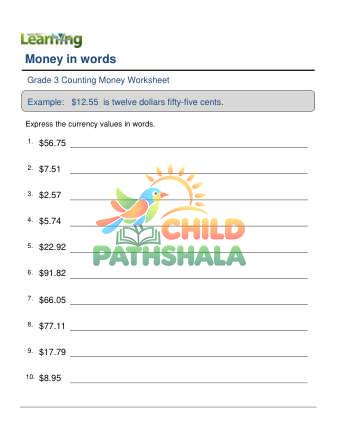
This is a 2-page pack — the thumbnail shows page 1 of 2. Words and themes pulled straight from the file include:
moneywordsgradecountingexampletwelvedollarsfiftyfivecentsexpresscurrencyvaluesseventy
Sample exercises from this page
- Money in words
- Grade 3 Counting Money Worksheet
- Example: $12.55 is twelve dollars fifty-five cents.
- Express the currency values in words.
- 1. $56.75
- 2. $7.51
- 3. $2.57
- 4. $5.74
- 5. $22.92
- 6. $91.82
Watch: Grade 3 Counting Money Canadian Shopping Problems A in action
▶ Now playing: Grade 1 Money Match Coin To Name 2
📺 Dedicated Watch Page →File details & curriculum alignment
Worksheet overview & learning goals
Teachers, this one is centre-friendly: Money In Words C runs itself once you have modeled the first line, making it ideal for Grade 3 Math rotations drawn from the Money In Words collection. The Money layout is calm and uncluttered, so even easily distracted learners settle into the work.
On this page, children work through Money In Words activities framed as Money practice. The difficulty sits at the Medium band for Grade 3 (ages 8–9), which means most children can attempt it independently after one guided example. That independence is the point: self-started pages build homework confidence faster than heavily assisted ones.
Still deciding whether to print? Open the preview and check the first row against what your child did in school this week. If it matches, print two copies — one for today, one for Friday — and watch familiarity turn into fluency before the weekend.
- Build number sense through guided Money practice at a Medium level
- Strengthen attention stamina with a satisfying finish-the-page arc
- Develop mathematical reasoning by explaining each answer aloud
- Create a portfolio trail of dated pages that makes growth visible
- Connect classroom math lessons to independent homework practice
- Make practice portable — prints cleanly for travel, waiting rooms, and weekends away
Download Full 6-Page Pack (ZIP Archive)
This page is part of the Money In Words bundle, a 6-page printable pack covering Money In Words for Grade 3. Single pages are perfect for tonight; the full pack is what you want for the week — download the whole bundle as one ZIP below and you will never scramble for tomorrow's practice again. You are looking at page 3 of 6 in this pack — it follows Money In Words B and leads into Money In Words D, so the difficulty steps up gradually. Working the pack in order gives the smoothest progression, though every page also stands alone. Don't waste time downloading one sheet at a time — get the entire set bundled in a clean, printable ZIP archive.
Also in this bundle
Money In Words AMoney In Words BMoney In Words DMoney In Words EMoney In Words F
Curriculum & skill alignment
Parents often ask where Grade 3 children actually get stuck in Money — and this page is built to reveal exactly that. Because every item isolates one money in words decision, a quick scan of the finished sheet shows the error pattern instantly: miscounts cluster at the top mean rushing, while errors scattered throughout usually signal a shaky method rather than carelessness. That diagnosis is gold, because the fix for rushing (slow down, check each line) differs completely from the fix for method gaps (re-teach with objects or drawings). Work the first row together and narrate your thinking; children imitate adult reasoning far more than adult instructions. Then let the page do its quiet work: ten minutes of independent Medium practice, followed by a two-minute review where the child explains one solved item back to you. Keep finished sheets for a month and compare early and late attempts side by side — the visible narrowing of error patterns is the clearest evidence that Money fluency is taking root, and it motivates better than any reward chart.
More Medium-band frontiers opening now: tackling word problems that need two operations, writing full paragraphs with topic sentences, and managing a weekly homework rhythm with minimal reminders. This is the season for study skills in disguise — checking work, using an eraser thoughtfully rather than catastrophically, and asking precise questions instead of announcing confusion. Introduce a simple self-score: after each Money page, your child predicts their mark before you check together, which trains the metacognition strong students rely on. Friendly competition with their own past scores (never siblings) keeps motivation healthy. Two money in words variants a week at this band, reviewed properly, will quietly move a Grade 3 learner from the middle of the pack toward its confident front.
Step-by-step parent & teacher guide
Print one copy per child, plus one extra for yourself so you can model the first two answers. Keep the session to ten or fifteen minutes, praise specific effort rather than speed, and end while the experience is still positive — you can always print a sibling variant tomorrow.
- Time-box the session to twelve minutes. The page is designed to fit, and ending while energy is high is what makes children ask for the next one.
- Agree on a finish line before the pencil touches paper — 'we stop after this row' beats watching the clock, and a finished row builds the habit of completion.
- Work in short bursts: two rows, a stretch, two more rows. Movement breaks between rows keep Grade 3 focus sharp to the final item.
- Close the loop the same day: review the dotted items together, let your child fix them personally, and choose tomorrow's sibling page on the spot. Same-day review converts practice into memory.
- Set up for success: clear a small workspace, lay out the printed page with a sharp pencil, and silence nearby screens. Two minutes of setup prevents twenty minutes of drifting attention.
Recommended supplies
Colored pencils beat markers for detail work on this page — they sharpen fine motor control and never bleed. Keep a handheld sharpener beside the practice spot; the sharpening pause doubles as a natural thinking break.
Extension activities
- Portfolio pick: at month's end, let your child choose their favourite finished page from the bundle and explain why. The conversation reveals more than any quiz sheet.
- Variant ladder: print two sibling pages from the Money In Words bundle and do one today, one in three days. Spaced repetition across variants is what converts a good session into a durable money in words skill.
- Teach-back round: let the child invent one similar problem for you to solve (and get deliberately stuck once). Teaching is the highest form of mastery, and Grade 3 children adore catching adult mistakes.
- Real-world mission: send your child to spot Money ideas in the wild — numbers on signs, letters on packaging, patterns on tiles. Photograph three finds and tape them beside the worksheet.
5 Steps to Skill Mastery for this Topic
Find exact learning gaps before practicing.
Screen-free pencil-on-paper completion.
Stuck on an item? Generate 3 mirror practice sheets.
Reinforce recall with interactive games.
Record mastery and print a diploma certificate.
Where to Go Next: 3-Tier Learning Ladder
Choose the best next step tailored to how your child performed on today’s worksheet:
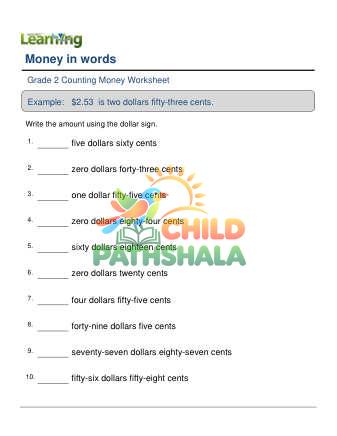
Money Words To Numbers F
Grade-2Rebuilds confidence with gentler foundational numbers and visual cues.
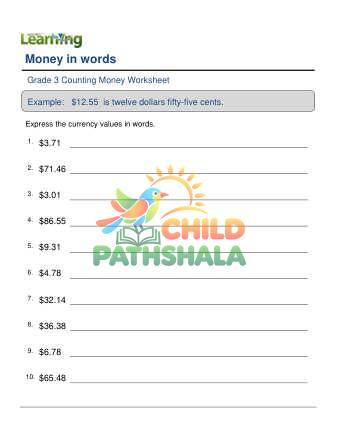
Money In Words D
Grade-3Parallel sibling practice to lock in muscle memory without memorization.

Advances to multi-step reasoning, higher numbers, or next grade level.
Keep practicing
Frequently asked questions
Is this money worksheet free for classroom use?
Yes — printing for a full class, a co-op, or a tutor's caseload is exactly what this library is for. Preview the page first so you know what every student will receive, then print the class set in one run. If you plan a whole unit around the Money In Words topic, the bundle ZIP gets you every sibling variant in a single download, which keeps week-two and week-three printing just as easy as today's.
How do I print this PDF without dark borders or cut-off edges?
Three quick habits make classroom printing painless: test one copy before the full set, set the copier to single-sided so nothing peeks through, and keep a master folder of downloaded PDFs so you never re-search for a page you already used. For this Money sheet specifically, normal print settings are fine — the design tolerates both laser and inkjet without losing legibility.
What age group is this printable best suited for?
A quick readiness check settles it: hand the child the page and watch the first row without helping. Smooth and confident means independent practice; hesitation means work the first two items together and then step back; total stall means swap in an easier sibling variant from the same bundle this week and revisit this one after a confidence-building page. The curriculum section above lists every Money In Words the page touches, so you can match it to what your class or child is covering this month rather than guessing.
What skills does this Grade 3 worksheet build?
If the first session felt smooth, extend it the following week by asking your child to predict which items will be easy before starting — metacognition like that multiplies the value of routine practice. If the session felt like a struggle, shrink the goal: cover all but one row with a sheet of paper and let the child 'unlock' rows one at a time. Either way, log the date on the finished page; dated pages from the Money In Words bundle become a progress story you can actually show.
The fastest route to a Money win this week is already on your screen: preview Money In Words C, print it, and let your child finish it unaided. When they ask for another, the bundle is one click away.
Designed for Screen-Free, Real Brain Growth
Instant PDF Downloads
One-click access to thousands of high-resolution printable activity sheets.
100% Ad-Free & Safe
Zero pop-up ads or distractions — a clean, safe learning environment for kids.
Hands-On Pencil Power
Pencil-to-paper exercises that develop fine motor control and writing confidence.
Curriculum Aligned (K–6)
Crafted by educators for Preschool, Kindergarten, and Grades 1 to 6.
Active Brain Building
Logic puzzles, mazes, and math challenges that build real focus and thinking skills.
15-Minute Daily Wins
Bite-sized worksheets that give children pride and joy of completion every day.
Wait! Don't leave empty-handed 👋
Take 10% off your first bundle
Hi! 👋 Looking for a specific worksheet, grade, or learning skill? Ask me anything below! 🙂