FREE Handwriting (Ages 5–12) 🎯 Print & Cursive Mastery 🇬🇧 UK: Penmanship (Y1–Y6) 🖨️ Tested for US Letter & A4 · Portrait
Practice Passages 19 Printable Worksheet for Handwriting
Practice Passages 19 Printable is a printable PDF worksheet for Handwriting (Handwriting › Handwriting). It belongs to the Practice Passages 19 Printable set and gives children one focused page of practice they can complete with a pencil, crayons, or a marker.
✏️ Practice On-Screen Download PDF Print ✨ Create Similar with AI
Resize & download
👨🏫 Parent Teaching Guide & Interactive Answer Key
Step-by-step solutions, parent teaching script, common pitfalls, and print grading rubric for Handwriting Practice Passages 19 Printable.
“Where do our letters always start? At the very top! Frog jump back up to the ceiling before curving around. Keep your pencil steady and let your wrist relax.”
Starting letters from the bottom baseline upwards, or pressing down so hard that the paper tears. Encourage gentle pencil pressure.
⏱️ 3-Minute Structured Home Teaching Plan:
Why Physical Pencil Writing Builds Stronger Neural Pathways
Preview this worksheet
✍️ Draw, Trace & Practice On-Screen
Inside this PDF
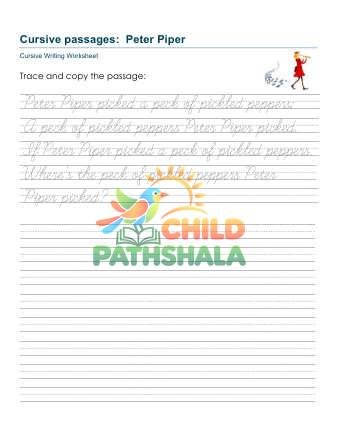
This is a single-page printable — what you see in the thumbnail is the whole sheet. Words and themes pulled straight from the file include:
cursivepassagespeterpiperwritingcopypassagepickedpeckpickledpeppers
Sample exercises from this page
- Cursive passages: Peter Piper
- Cursive Writing Worksheet
- Trace and copy the passage:
- Peter Piper picked a peck of pickled peppers;
- A peck of pickled peppers Peter Piper picked.
- If Peter Piper picked a peck of pickled peppers.
- Where’s the peck of pickled peppers Peter
- Piper picked?
Watch: Tracing in action
▶ Now playing: Tracing
📺 Dedicated Watch Page →File details & curriculum alignment
Worksheet overview & learning goals
Practice Passages 19 Printable is a printable Handwriting worksheet in Handwriting (Handwriting) from the Practice Passages 19 Printable collection. It delivers one focused page of practice that a child can finish in a single sitting — preview it below, print it in one click, and you have instant Handwriting work for morning routines, homework, tutoring, or weekend catch-up.
The All levels difficulty is calibrated for Handwriting (ages 5–12). Stronger students will move briskly and can follow up with a sibling variant from the same bundle, while children finding it tricky should do the first two items together with an adult, then continue solo — the page is structured to support exactly that handover.
The Practice Passages 19 Printable collection behind this page contains many sibling variants, so Practice Passages 19 Printable is a doorway, not a dead end. Finish it, celebrate loudly, and let your child pick the next page themselves — choice is rocket fuel for Handwriting motivation.
- Strengthen attention stamina with a satisfying finish-the-page arc
- Practice consistent letter formation within ruled guides
- Create a portfolio trail of dated pages that makes growth visible
- Improve spacing, sizing, and baseline control
- Support mixed-ability groups — fast finishers simply move on to sibling pages
- Prepare hands for longer classroom writing tasks
Included in a printable bundle
This page is part of the Practice Passages 19 Printable bundle, a 1-page printable pack covering Practice Passages 19 Printable for Handwriting. Single pages are perfect for tonight; the full pack is what you want for the week — download the whole bundle as one ZIP below and you will never scramble for tomorrow's practice again. You are looking at page 1 of 1 in this pack. Working the pack in order gives the smoothest progression, though every page also stands alone.
Download full 1-page bundle (ZIP) See all pages in Practice Passages 19 Printable
Curriculum & skill alignment
This Handwriting handwriting printable focuses on Handwriting through the Practice Passages 19 Printable line set, training the small hand muscles that fluent writing depends on. At the All levels stage, the priority is formation before speed: children trace each shape slowly, saying the stroke path aloud, and only then attempt the same line independently. The ruled guides do quiet coaching work — midlines whisper where curves should peak, baselines catch drifting tails, and consistent spacing boxes teach the eye what even writing looks like. Short daily practice of a single page beats occasional marathon sessions, because muscle memory forms through repetition across days, not minutes within one sitting. Parents should watch grip first and letter shapes second: a relaxed tripod grip with the paper tilted slightly will fix more wobbles than any amount of erasing. Teachers use sheets like this for warm-ups, literacy centers, and take-home practice, and the skills transfer directly to every other subject, since nearly all Handwriting assessment still travels through a pencil.
Across ages, the milestones that mark real progress are independence, accuracy under mild time pressure, and the willingness to attempt harder variants. This page meets learners wherever they are: younger children can complete it with light guidance while older ones use it as fluent warm-up. The constant is routine — short, regular sessions with immediate review beat occasional marathons at every age. Keep finished pages in a portfolio folder; visible growth is the most powerful motivator a young learner can own.
Step-by-step parent & teacher guide
Set up a calm corner with the printed page, a sharp pencil, and an eraser. Walk through the example line together, agree on a stopping point, and let the child own the rest. Collect the finished page in a folder; flipping back through finished work is one of the strongest motivators young learners have.
- Agree on a finish line before the pencil touches paper — 'we stop after this row' beats watching the clock, and a finished row builds the habit of completion.
- Review and celebrate: check answers together, revisit any misses as a team, and file the page. Then pick the next variant from the bundle to lock in the practice passages 19 printable skill while it is fresh.
- Give the pencil fully to the child from item one. Even wobbly first attempts done solo teach more than perfect answers done by an adult.
- Set up for success: clear a small workspace, lay out the printed page with a sharp pencil, and silence nearby screens. Two minutes of setup prevents twenty minutes of drifting attention.
Recommended supplies
Skip the fancy supplies. One printed page, one pencil, one eraser — that is the entire kit. Children at the All levels stage do their best work when the materials are boring and the task is clear.
Extension activities
- Colour-code review: circle the easiest answer in green and the trickiest in orange, then ask why the orange one felt harder. The explanation is the real lesson hiding inside the page.
- Story swap: ask your child to make up a tiny story using the items or answers on the page. Nonsense is fine — the blending of Handwriting ideas with narrative is the exercise.
- Gallery walk: tape the finished Handwriting page at eye level and let your child present it like a museum guide. Narrating their own work cements Practice Passages 19 Printable vocabulary better than any quiz.
5 Steps to Skill Mastery for this Topic
Find exact learning gaps before practicing.
Screen-free pencil-on-paper completion.
Stuck on an item? Generate 3 mirror practice sheets.
Reinforce recall with interactive games.
Record mastery and print a diploma certificate.
Where to Go Next: 3-Tier Learning Ladder
Choose the best next step tailored to how your child performed on today’s worksheet:
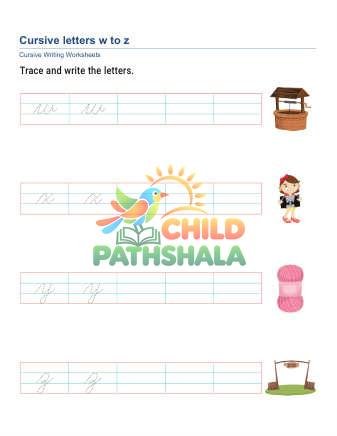
W Z Lowercase
HandwritingParallel sibling practice to lock in muscle memory without memorization.
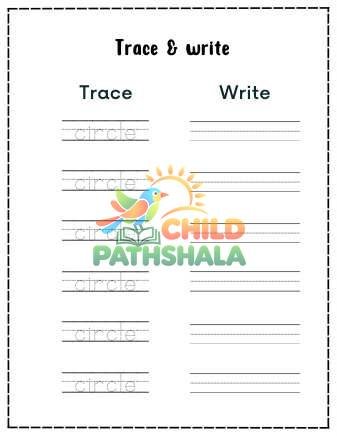
Trace And Write
Grade-1Advances to multi-step reasoning, higher numbers, or next grade level.
Keep practicing
Frequently asked questions
Is this handwriting worksheet free for classroom use?
Yes. This Handwriting Handwriting page is free to preview, download, and print for your classroom, homeschool, or family. Print one copy per student for in-class work, homework, or learning centers — there are no per-student fees and no watermark on the printed page. If colleagues need it too, share the page link rather than the file so they always get the latest version. For school-wide distribution across many classrooms, keep a bookmark to the bundle page so every teacher prints from the same source. Because previews are free, you can verify alignment with your lesson plan before printing a single copy — a small habit that saves considerable paper over a school year. Child Pathshala is a download-and-print library: you print on your own printer — we never ship physical worksheets.
How do I print this PDF without dark borders or cut-off edges?
Open the free preview first to confirm the layout, then print at 100 percent scale (sometimes labeled Actual Size) on US Letter or A4 — the page is designed for both. If edges clip, switch the printer dialog from Borderless to Normal margins, which restores the safe zone most home printers need. For daily classroom runs, draft or grayscale mode saves ink with no loss of clarity, since all instructions use high-contrast type. Printing single-sided is best when children use markers, as ink can ghost through thin paper onto whatever waits beneath. If colors print too dark on your machine, choose Grayscale or Draft mode; the high-contrast layout stays fully legible while using a fraction of the ink.
What age group is this printable best suited for?
Use this quick placement check: have your child try the first row with no help. Fluent and confident means the All levels band fits and you can assign the page independently. One or two wobbles means do those items together, then release the rest — the page is doing its job as instruction, not just assessment. Broad struggle across every row signals the level is a step too high right now; drop to an easier sibling variant for two weeks, then return. Conversely, a child who finishes in minutes with total accuracy is ready for the next Handwriting variant up. Re-check placement each term, because Handwriting growth spurts arrive suddenly and change everything.
What skills does this Handwriting worksheet build?
The headline skills are develop correct pencil grip and relaxed hand posture, practice consistent letter formation within ruled guides, build muscle memory through traced then independent handwriting lines. Beneath those, the page quietly trains work habits: reading instructions independently, checking answers, persisting through a full page, and taking pride in finished work. Because it belongs to the Practice Passages 19 Printable collection, repeating the skill with sibling variants compounds the effect — each new page reuses the same thinking in a fresh layout. After three or four variants, most Handwriting learners show visibly faster, more confident Handwriting work, which is the moment to celebrate and move the progression forward. Revisit this page monthly alongside new variants to make growth visible — children who see their own progress attempt harder pages willingly.
Grab the free PDF above while it is on your mind — practice pages have a way of staying in folders forever and helping every school year after. Practice Passages 19 Printable pairs naturally with its sibling variants whenever you need a fresh round.