FREE Handwriting (Ages 5–12) 🎯 Print & Cursive Mastery 🇬🇧 UK: Penmanship (Y1–Y6) 🖨️ Tested for US Letter & A4 · Portrait
Practice Passages 1 Printable Worksheet for Handwriting
Practice Passages 1 Printable is a printable PDF worksheet for Handwriting (Handwriting › Handwriting). It belongs to the Practice Passages 1 Printable set and gives children one focused page of practice they can complete with a pencil, crayons, or a marker.
✏️ Practice On-Screen Download PDF Print ✨ Create Similar with AI
Resize & download
👨🏫 Parent Teaching Guide & Interactive Answer Key
Step-by-step solutions, parent teaching script, common pitfalls, and print grading rubric for Handwriting Practice Passages 1 Printable.
“Where do our letters always start? At the very top! Frog jump back up to the ceiling before curving around. Keep your pencil steady and let your wrist relax.”
Starting letters from the bottom baseline upwards, or pressing down so hard that the paper tears. Encourage gentle pencil pressure.
⏱️ 3-Minute Structured Home Teaching Plan:
Why Physical Pencil Writing Builds Stronger Neural Pathways
Preview this worksheet
✍️ Draw, Trace & Practice On-Screen
Inside this PDF
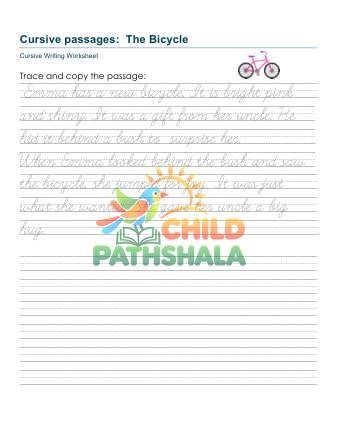
This is a single-page printable — what you see in the thumbnail is the whole sheet. Words and themes pulled straight from the file include:
cursivepassagesbicyclewritingcopypassageemmabrightpinkshinygiftunclebehindbush
Sample exercises from this page
- Cursive passages: The Bicycle
- Cursive Writing Worksheet
- Trace and copy the passage:
- Emma has a new bicycle. It is bright pink
- and shiny. It was a gift from her uncle. He
- hid it behind a bush to surprise her.
- When Emma looked behind the bush and saw
- the bicycle, she jumped for joy. It was just
- what she wanted. She gave her uncle a big
- hug.
Watch: Tracing in action
▶ Now playing: Tracing
📺 Dedicated Watch Page →File details & curriculum alignment
Worksheet overview & learning goals
This Handwriting Handwriting page, Practice Passages 1 Printable, belongs to the Practice Passages 1 Printable collection in Handwriting. It is built for real life: one page, zero prep, free preview, and print-ready output that looks crisp on both home printers and school copiers.
Wondering if the level fits? Handwriting (ages 5–12) is the sweet spot, and the All levels band means the page challenges without crushing. If your child stalls on item three, do it together and release the rest — that gradual handover is exactly how Handwriting confidence is built.
This page works anywhere a printer lives: classrooms, homeschool tables, tutoring sessions, libraries, and travel binders. Because it is self-contained, no answer key hunt or extra materials are needed — learning starts the moment the page lands on the desk.
- Reinforce classroom Handwriting lessons with take-home Practice Passages 1 Printable practice
- Practice consistent letter formation within ruled guides
- Support mixed-ability groups — fast finishers simply move on to sibling pages
- Improve spacing, sizing, and baseline control
- Build test readiness through calm, low-stakes Handwriting repetition
- Prepare hands for longer classroom writing tasks
Included in a printable bundle
This page is part of the Practice Passages 1 Printable bundle, a 1-page printable pack covering Practice Passages 1 Printable for Handwriting. Single pages are perfect for tonight; the full pack is what you want for the week — download the whole bundle as one ZIP below and you will never scramble for tomorrow's practice again. You are looking at page 1 of 1 in this pack. Working the pack in order gives the smoothest progression, though every page also stands alone.
Download full 1-page bundle (ZIP) See all pages in Practice Passages 1 Printable
Curriculum & skill alignment
This Handwriting handwriting printable focuses on Handwriting through the Practice Passages 1 Printable line set, training the small hand muscles that fluent writing depends on. At the All levels stage, the priority is formation before speed: children trace each shape slowly, saying the stroke path aloud, and only then attempt the same line independently. The ruled guides do quiet coaching work — midlines whisper where curves should peak, baselines catch drifting tails, and consistent spacing boxes teach the eye what even writing looks like. Short daily practice of a single page beats occasional marathon sessions, because muscle memory forms through repetition across days, not minutes within one sitting. Parents should watch grip first and letter shapes second: a relaxed tripod grip with the paper tilted slightly will fix more wobbles than any amount of erasing. Teachers use sheets like this for warm-ups, literacy centers, and take-home practice, and the skills transfer directly to every other subject, since nearly all Handwriting assessment still travels through a pencil.
Across ages, the milestones that mark real progress are independence, accuracy under mild time pressure, and the willingness to attempt harder variants. This page meets learners wherever they are: younger children can complete it with light guidance while older ones use it as fluent warm-up. The constant is routine — short, regular sessions with immediate review beat occasional marathons at every age. Keep finished pages in a portfolio folder; visible growth is the most powerful motivator a young learner can own.
Step-by-step parent & teacher guide
Everything on this page is self-contained, so preparation is just printing. If your child tends to rush, fold the sheet so only one row shows at a time; if they tend to stall, do the first item with them and set a friendly timer for the rest.
- Agree on a finish line before the pencil touches paper — 'we stop after this row' beats watching the clock, and a finished row builds the habit of completion.
- Close the loop the same day: review the dotted items together, let your child fix them personally, and choose tomorrow's sibling page on the spot. Same-day review converts practice into memory.
- Read the instructions aloud once together, then have your child re-read them silently before starting; the double pass prevents half the usual 'what do I do?' interruptions.
- Narrate the thinking: ask your child to say each step out loud before writing it. Spoken reasoning catches slips before they reach the page.
Recommended supplies
Keep it simple: printed page, pencils, eraser, and colored pencils for any creative stretches. Avoid pens at this stage so mistakes stay fixable, and keep a second printed copy handy — siblings and retry attempts have a way of appearing exactly when the printer is off. A timer adds gentle structure for children who dawdle, while a sticker on each finished page works wonders for ages 5–12 motivation.
Extension activities
- Error hunt game: you complete a sibling page with three sneaky mistakes planted, and your child plays teacher with a red pencil. Detecting errors in Handwriting work builds sharper self-checking than perfect practice ever could.
- Story swap: ask your child to make up a tiny story using the items or answers on the page. Nonsense is fine — the blending of Handwriting ideas with narrative is the exercise.
- Two-day remix: reprint the same page after 48 hours and race yesterday's time — children love proving to themselves that the page got easier.
- Real-world mission: send your child to spot Handwriting ideas in the wild — numbers on signs, letters on packaging, patterns on tiles. Photograph three finds and tape them beside the worksheet.
5 Steps to Skill Mastery for this Topic
Find exact learning gaps before practicing.
Screen-free pencil-on-paper completion.
Stuck on an item? Generate 3 mirror practice sheets.
Reinforce recall with interactive games.
Record mastery and print a diploma certificate.
Where to Go Next: 3-Tier Learning Ladder
Choose the best next step tailored to how your child performed on today’s worksheet:
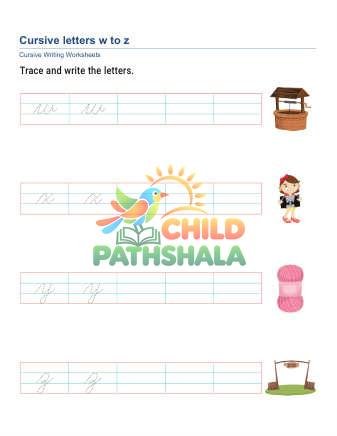
W Z Lowercase
HandwritingParallel sibling practice to lock in muscle memory without memorization.

Trace Letter M
Grade-1Advances to multi-step reasoning, higher numbers, or next grade level.
Keep practicing
Frequently asked questions
Is this handwriting worksheet free for classroom use?
Yes — printing for a full class, a co-op, or a tutor's caseload is exactly what this library is for. Preview the page first so you know what every student will receive, then print the class set in one run. If you plan a whole unit around the Practice Passages 1 Printable topic, the bundle ZIP gets you every sibling variant in a single download, which keeps week-two and week-three printing just as easy as today's.
How do I print this PDF without dark borders or cut-off edges?
School copiers behave differently from home printers: choose single-sided, normal contrast, and 100 percent scale for the cleanest class sets. If your copier darkens backgrounds, lighten the copy density one notch — the bold Handwriting lines stay crisp while gray wash disappears. Printing from a phone or tablet works fine through any PDF reader; just confirm US Letter or A4 in the print preview first. For laminated reuse, print once on cardstock, slip the sheet into a dry-erase pocket, and hand out whiteboard markers — one print serves the whole term. Whatever the machine, always run a single test copy before committing to thirty.
What age group is this printable best suited for?
A quick readiness check settles it: hand the child the page and watch the first row without helping. Smooth and confident means independent practice; hesitation means work the first two items together and then step back; total stall means swap in an easier sibling variant from the same bundle this week and revisit this one after a confidence-building page. The curriculum section above lists every Practice Passages 1 Printable the page touches, so you can match it to what your class or child is covering this month rather than guessing.
What skills does this Handwriting worksheet build?
If the first session felt smooth, extend it the following week by asking your child to predict which items will be easy before starting — metacognition like that multiplies the value of routine practice. If the session felt like a struggle, shrink the goal: cover all but one row with a sheet of paper and let the child 'unlock' rows one at a time. Either way, log the date on the finished page; dated pages from the Practice Passages 1 Printable bundle become a progress story you can actually show.
One page today, a confident learner tomorrow. Preview Practice Passages 1 Printable free above, print it in seconds, and keep the Practice Passages 1 Printable bundle bookmarked for the rest of the week. Bookmark the bundle page so tomorrow's print is one click away.