FREE Grade 2 (Ages 7–8) 🎯 CCSS Grade 2 / UK KS1 🇬🇧 UK: Year 2 (KS1) 🖨️ Tested for US Letter & A4 · Portrait
Paragraph Words 4 Worksheet for Grade 2
Paragraph Words 4 is a printable PDF worksheet for Grade 2 (ELA › Writing). It belongs to the Paragraph Words set and gives children one focused page of practice they can complete with a pencil, crayons, or a marker.
✏️ Practice On-Screen Download PDF Print ✨ Create Similar with AI
Resize & download
👨🏫 Parent Teaching Guide & Interactive Answer Key
Step-by-step solutions, parent teaching script, common pitfalls, and print grading rubric for Grade 2 Paragraph Words 4.
“Where do our letters always start? At the very top! Frog jump back up to the ceiling before curving around. Keep your pencil steady and let your wrist relax.”
Starting letters from the bottom baseline upwards, or pressing down so hard that the paper tears. Encourage gentle pencil pressure.
⏱️ 3-Minute Structured Home Teaching Plan:
Why Physical Pencil Writing Builds Stronger Neural Pathways
Preview this worksheet
✍️ Draw, Trace & Practice On-Screen
Inside this PDF

This is a 2-page pack — the thumbnail shows page 1 of 2. Words and themes pulled straight from the file include:
vocabularyparagraphsgradefillmissingwordsconcerttonightstudentsdressniceclothesfrontshawn
Sample exercises from this page
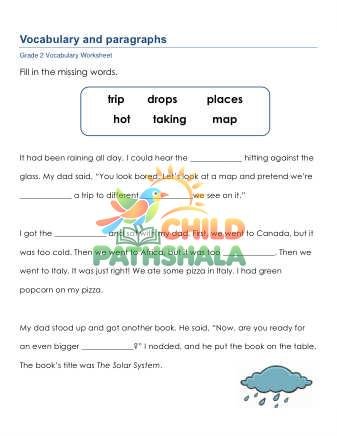
- Vocabulary and paragraphs
- Grade 2 Vocabulary Worksheet
- Fill in the missing words.
- The concert was tonight. The students had to dress in nice clothes and ________
- in front of a big ___________.
- Shawn was _____________, but worried. What if he couldn’t find the ___________
- section where he was supposed to stand? What if he _____________ his notes or
- played bad?
- The clock struck five o’clock. It was time to enter the concert hall. Shawn drank
- a _____________ of water. He took some deep _____________. In his mind, he
Watch: Child Pathshala Printables in action
▶ Now playing: Child Pathshala Printables
📺 Dedicated Watch Page →File details & curriculum alignment
Worksheet overview & learning goals
Looking for Grade 2 ELA practice that actually gets finished? Paragraph Words 4 covers Writing through the Paragraph Words set on a single clean page. The format is deliberately simple: clear instructions, large print, and room to write, so children spend their energy on learning instead of figuring out the worksheet.
Everything about the layout serves ages 7–8 attention spans: one skill per page, items ordered from warm-up to gentle stretch, and enough white space that the page never feels crowded. Easy learners stay engaged when success arrives early, so the opening items are designed to be winnable within the first minute.
Printing and preparation could not be simpler: open the preview, confirm the page, and print single-sided. Keep a folder of finished Writing pages — flipping back through completed work shows children how far they have come and motivates the next session.
- Build Grade 2 Writing skills through the focused Paragraph Words set
- Make practice portable — prints cleanly for travel, waiting rooms, and weekends away
- Grow vocabulary and comprehension one page at a time
- Strengthen attention stamina with a satisfying finish-the-page arc
- Bridge classroom lessons and home practice seamlessly
- Create a portfolio trail of dated pages that makes growth visible
Included in a printable bundle
This page is part of the Paragraph Words bundle, a 4-page printable pack covering Paragraph Words for Grade 2. Single pages are perfect for tonight; the full pack is what you want for the week — download the whole bundle as one ZIP below and you will never scramble for tomorrow's practice again. You are looking at page 4 of 4 in this pack — it follows Paragraph Words 3 as the difficulty steps up. Working the pack in order gives the smoothest progression, though every page also stands alone.
Download full 4-page bundle (ZIP) See all pages in Paragraph Words
Also in this bundle
Paragraph Words 1Paragraph Words 2Paragraph Words 3
Curriculum & skill alignment
Reading and writing grow together, and this Grade 2 Writing page feeds both directions of that loop. After your child completes the paragraph words items, flip the task: dictate two similar items aloud and let them write the answers from hearing alone — dictation is the bridge between reading recognition and true spelling power. Keep a personal word wall where tricky Writing words from these pages earn a sticky note; reviewing the wall for sixty seconds before each new sheet compounds vocabulary remarkably fast. Read-aloud time multiplies the effect: hearing fluent adult reading models the phrasing and expression that silent worksheets cannot teach. At the Easy stage, aim for the page plus ten minutes of shared reading daily, and Grade 2 literacy will advance on two fronts at once. Celebrate finished pages concretely — a dated folder, a proud display — because children who see themselves as readers and writers willingly attempt harder Writing work next.
A second set of Easy-band wins to watch for: writing their own first name without a model, counting to twenty with one-to-one pointing, and retelling the steps of a finished Writing page in order. Daily rhythms matter enormously now — same practice time, same spot, same pencil — because predictability frees working memory for learning. Expect big day-to-day swings; a tired five-year-old is a different learner than a rested one, and pushing through fatigue teaches nothing but dislike. Instead, bank the good days: when focus is high, do the page plus one sibling paragraph words variant back to back. Keep language playful and concrete, celebrate process over product, and trust that these small Grade 2 routines are laying rails that later schooling will run on smoothly.
Step-by-step parent & teacher guide
The only real preparation is a pencil sharpener and a flat surface. Print the page, sit within earshot, and let your child read the instructions aloud once — that thirty-second ritual quietly checks comprehension and settles wiggles before work begins.
- Independent practice: hand over the pencil. Stay close enough to answer questions but far enough that the child feels ownership — this is where Easy stamina is built.
- Work in short bursts: two rows, a stretch, two more rows. Movement breaks between rows keep Grade 2 focus sharp to the final item.
- Time-box the session to twelve minutes. The page is designed to fit, and ending while energy is high is what makes children ask for the next one.
- Give the pencil fully to the child from item one. Even wobbly first attempts done solo teach more than perfect answers done by an adult.
- Model the first items: do the opening two together, thinking aloud as you go. Hearing an adult reason through paragraph words work teaches the method, not just the answer.
Recommended supplies
You need almost nothing: the printed page, a pencil with an eraser, and optionally crayons or washable markers if the Writing theme invites color. A clipboard helps for couch or floor work, and a simple folder keeps finished pages — the cheapest progress portfolio ever assembled. A kitchen timer can help too: visible countdowns turn practice into a friendly beat-the-clock game for Easy learners.
Extension activities
- Real-world mission: send your child to spot Writing ideas in the wild — numbers on signs, letters on packaging, patterns on tiles. Photograph three finds and tape them beside the worksheet.
- Variant ladder: print two sibling pages from the Paragraph Words bundle and do one today, one in three days. Spaced repetition across variants is what converts a good session into a durable paragraph words skill.
- Count and describe: have the child count objects, shapes, or answers on the page, then describe them — color, size, position. This ten-second extension turns any ELA page into oral-language practice.
5 Steps to Skill Mastery for this Topic
Find exact learning gaps before practicing.
Screen-free pencil-on-paper completion.
Stuck on an item? Generate 3 mirror practice sheets.
Reinforce recall with interactive games.
Record mastery and print a diploma certificate.
Where to Go Next: 3-Tier Learning Ladder
Choose the best next step tailored to how your child performed on today’s worksheet:

Explanatory Writing Prompts D
Grade-1Rebuilds confidence with gentler foundational numbers and visual cues.
Paragraph Words 1
Grade-2Parallel sibling practice to lock in muscle memory without memorization.

Verb Raise Rise Rose
Grade-3Advances to multi-step reasoning, higher numbers, or next grade level.
Keep practicing
Frequently asked questions
Is this writing worksheet free for classroom use?
Absolutely — and that includes homeschool co-ops, tutoring centers, and after-school programs, not just traditional classrooms. There is no seat limit and no licensing paperwork for normal educational use: preview, print, and teach. The one request we make is simple — link colleagues to this page instead of emailing the file around, so everyone prints the current version. Heavy users running hundreds of copies a month should use draft mode and the bundle ZIP to keep printing budgets sane. If your school needs documentation for approved-resource lists, this page's curriculum section above describes the skill alignment in administrator-friendly language.
How do I print this PDF without dark borders or cut-off edges?
Open the free preview first to confirm the layout, then print at 100 percent scale (sometimes labeled Actual Size) on US Letter or A4 — the page is designed for both. If edges clip, switch the printer dialog from Borderless to Normal margins, which restores the safe zone most home printers need. For daily classroom runs, draft or grayscale mode saves ink with no loss of clarity, since all instructions use high-contrast type. Printing single-sided is best when children use markers, as ink can ghost through thin paper onto whatever waits beneath. If colors print too dark on your machine, choose Grayscale or Draft mode; the high-contrast layout stays fully legible while using a fraction of the ink.
What age group is this printable best suited for?
Use this quick placement check: have your child try the first row with no help. Fluent and confident means the Easy band fits and you can assign the page independently. One or two wobbles means do those items together, then release the rest — the page is doing its job as instruction, not just assessment. Broad struggle across every row signals the level is a step too high right now; drop to an easier sibling variant for two weeks, then return. Conversely, a child who finishes in minutes with total accuracy is ready for the next Writing variant up. Re-check placement each term, because Grade 2 growth spurts arrive suddenly and change everything.
What skills does this Grade 2 worksheet build?
The headline skills are build grade 2 writing skills through the focused paragraph words set, strengthen core literacy with short, success-sized practice, grow vocabulary and comprehension one page at a time. Beneath those, the page quietly trains work habits: reading instructions independently, checking answers, persisting through a full page, and taking pride in finished work. Because it belongs to the Paragraph Words collection, repeating the skill with sibling variants compounds the effect — each new page reuses the same thinking in a fresh layout. After three or four variants, most Grade 2 learners show visibly faster, more confident Writing work, which is the moment to celebrate and move the progression forward. Revisit this page monthly alongside new variants to make growth visible — children who see their own progress attempt harder pages willingly.
Ten focused minutes is the whole commitment: preview Paragraph Words 4 above, print, and hand over the pencil. The finished page joins the folder, the folder becomes the portfolio, and the portfolio becomes proof of how far Grade 2 practice has come.