FREE Grade 2 (Ages 7–8) 🎯 CCSS Grade 2 / UK KS1 🇬🇧 UK: Year 2 (KS1) 🖨️ Tested for US Letter & A4 · Portrait
Add 3 Single Digit Numbers F Worksheet for Grade 2
Add 3 Single Digit Numbers F is a printable PDF worksheet for Grade 2 (Math › Addition). It belongs to the Add 3 Single Digit Numbers set and gives children one focused page of practice they can complete with a pencil, crayons, or a marker.
✏️ Practice On-Screen Download PDF Print ✨ Create Similar with AI
Resize & download
👨🏫 Parent Teaching Guide & Interactive Answer Key
Step-by-step solutions, parent teaching script, common pitfalls, and print grading rubric for Grade 2 Add 3 Single Digit Numbers F.
“Always start with the friendly ones column on the far right! If our ones make a two-digit number like 14, the 4 stays downstairs and the 1 takes the elevator up to the tens house!”
Subtracting the smaller top digit from the larger bottom digit without regrouping (e.g. 52 - 17 calculated as 45 instead of 35). Always ask: “Do we have enough on top?”
⏱️ 3-Minute Structured Home Teaching Plan:
Why Physical Pencil Writing Builds Stronger Neural Pathways
Preview this worksheet
✍️ Draw, Trace & Practice On-Screen
Inside this PDF

This is a 2-page pack — the thumbnail shows page 1 of 2. Words and themes pulled straight from the file include:
singledigitgradeadditionfind
Sample exercises from this page
- Add 3 single-digit numbers
- Grade 2 Addition Worksheet
- Find the sum.
- 4 + 3 + 5 =
- 8 + 0 + 2 =
- 4 + 3 + 7 =
- 4 + 5 + 5 =
- 0 + 3 + 2 =
- 2 + 5 + 5 =
- 5 + 2 + 9 =
Watch: Numbers in action
▶ Now playing: Numbers
📺 Dedicated Watch Page →File details & curriculum alignment
Worksheet overview & learning goals
Meet Add 3 Single Digit Numbers F: a Grade 2 Math printable that turns Addition practice into a win your child can finish before the timer runs out. Sourced from the Add 3 Single Digit Numbers collection, it keeps the focus tight — one skill, one page, one proud finished sheet for the fridge door.
Here is the thing about Easy practice: frequency beats duration. Five focused minutes on Add 3 Single Digit Numbers F today plus a sibling page on Thursday will move Add 3 Single Digit Numbers further than a single Sunday marathon. The page is engineered for that rhythm — short enough to finish, substantial enough to matter.
Pair this sheet with its bundle siblings for a full week of Add 3 Single Digit Numbers practice without repeating a single question. Three short sessions across seven days will do more for retention than one long sitting, and each finished page earns its place on the fridge.
- Build number sense through guided Addition practice at a Easy level
- Give Grade 2 learners a visible win in under fifteen focused minutes
- Develop mathematical reasoning by explaining each answer aloud
- Build test readiness through calm, low-stakes Addition repetition
- Connect classroom math lessons to independent homework practice
- Reinforce classroom Math lessons with take-home Add 3 Single Digit Numbers practice
Included in a printable bundle
This page is part of the Add 3 Single Digit Numbers bundle, a 6-page printable pack covering Add 3 Single Digit Numbers for Grade 2. Single pages are perfect for tonight; the full pack is what you want for the week — download the whole bundle as one ZIP below and you will never scramble for tomorrow's practice again. You are looking at page 6 of 6 in this pack — it follows Add 3 Single Digit Numbers E as the difficulty steps up. Working the pack in order gives the smoothest progression, though every page also stands alone.
Download full 6-page bundle (ZIP) See all pages in Add 3 Single Digit Numbers
Also in this bundle
Add 3 Single Digit Numbers AAdd 3 Single Digit Numbers BAdd 3 Single Digit Numbers CAdd 3 Single Digit Numbers DAdd 3 Single Digit Numbers E
Curriculum & skill alignment
Parents often ask where Grade 2 children actually get stuck in Addition — and this page is built to reveal exactly that. Because every item isolates one add 3 single digit numbers decision, a quick scan of the finished sheet shows the error pattern instantly: miscounts cluster at the top mean rushing, while errors scattered throughout usually signal a shaky method rather than carelessness. That diagnosis is gold, because the fix for rushing (slow down, check each line) differs completely from the fix for method gaps (re-teach with objects or drawings). Work the first row together and narrate your thinking; children imitate adult reasoning far more than adult instructions. Then let the page do its quiet work: ten minutes of independent Easy practice, followed by a two-minute review where the child explains one solved item back to you. Keep finished sheets for a month and compare early and late attempts side by side — the visible narrowing of error patterns is the clearest evidence that Addition fluency is taking root, and it motivates better than any reward chart.
A second set of Easy-band wins to watch for: writing their own first name without a model, counting to twenty with one-to-one pointing, and retelling the steps of a finished Addition page in order. Daily rhythms matter enormously now — same practice time, same spot, same pencil — because predictability frees working memory for learning. Expect big day-to-day swings; a tired five-year-old is a different learner than a rested one, and pushing through fatigue teaches nothing but dislike. Instead, bank the good days: when focus is high, do the page plus one sibling add 3 single digit numbers variant back to back. Keep language playful and concrete, celebrate process over product, and trust that these small Grade 2 routines are laying rails that later schooling will run on smoothly.
Step-by-step parent & teacher guide
Keep a 'practice tray' ready — three printed pages from this bundle, two pencils, an eraser, and a small sticker sheet. When the moment for practice appears, there is nothing to prepare and every excuse has already been removed.
- Do a guided start: complete the first three items as a team, with your child holding the pencil and you asking guiding questions about each add 3 single digit numbers decision. Then announce the handover clearly — kids rise to explicit independence.
- Agree on a finish line before the pencil touches paper — 'we stop after this row' beats watching the clock, and a finished row builds the habit of completion.
- Close the loop the same day: review the dotted items together, let your child fix them personally, and choose tomorrow's sibling page on the spot. Same-day review converts practice into memory.
- Print and preview: open the free preview below to confirm the page matches your lesson, then download or print. One copy per child, single-sided so markers never bleed onto a second activity.
Recommended supplies
Keep it simple: printed page, pencils, eraser, and colored pencils for any creative stretches. Avoid pens at this stage so mistakes stay fixable, and keep a second printed copy handy — siblings and retry attempts have a way of appearing exactly when the printer is off. A timer adds gentle structure for children who dawdle, while a sticker on each finished page works wonders for ages 7–8 motivation.
Extension activities
- Talk it up: after finishing, ask the child to explain one answer in full sentences. Verbalizing Addition thinking builds vocabulary and reveals understanding gaps that silent worksheets hide.
- Variant ladder: print two sibling pages from the Add 3 Single Digit Numbers bundle and do one today, one in three days. Spaced repetition across variants is what converts a good session into a durable add 3 single digit numbers skill.
- Colour-code review: circle the easiest answer in green and the trickiest in orange, then ask why the orange one felt harder. The explanation is the real lesson hiding inside the page.
- Two-day remix: reprint the same page after 48 hours and race yesterday's time — children love proving to themselves that the page got easier.
5 Steps to Skill Mastery for this Topic
Find exact learning gaps before practicing.
Screen-free pencil-on-paper completion.
Stuck on an item? Generate 3 mirror practice sheets.
Reinforce recall with interactive games.
Record mastery and print a diploma certificate.
Where to Go Next: 3-Tier Learning Ladder
Choose the best next step tailored to how your child performed on today’s worksheet:

Addition Facts Practice C
Grade-1Rebuilds confidence with gentler foundational numbers and visual cues.

Add 3 Single Digit Numbers D
Grade-2Parallel sibling practice to lock in muscle memory without memorization.
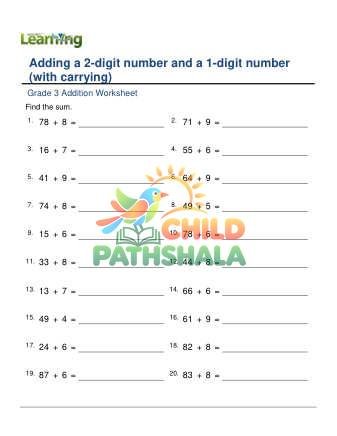
Adding 2 Digit Plus 1 Digit E
Grade-3Advances to multi-step reasoning, higher numbers, or next grade level.
Keep practicing
Frequently asked questions
Is this addition worksheet free for classroom use?
Yes. This Grade 2 Addition page is free to preview, download, and print for your classroom, homeschool, or family. Print one copy per student for in-class work, homework, or learning centers — there are no per-student fees and no watermark on the printed page. If colleagues need it too, share the page link rather than the file so they always get the latest version. For school-wide distribution across many classrooms, keep a bookmark to the bundle page so every teacher prints from the same source. Because previews are free, you can verify alignment with your lesson plan before printing a single copy — a small habit that saves considerable paper over a school year. Child Pathshala is a download-and-print library: you print on your own printer — we never ship physical worksheets.
How do I print this PDF without dark borders or cut-off edges?
School copiers behave differently from home printers: choose single-sided, normal contrast, and 100 percent scale for the cleanest class sets. If your copier darkens backgrounds, lighten the copy density one notch — the bold Addition lines stay crisp while gray wash disappears. Printing from a phone or tablet works fine through any PDF reader; just confirm US Letter or A4 in the print preview first. For laminated reuse, print once on cardstock, slip the sheet into a dry-erase pocket, and hand out whiteboard markers — one print serves the whole term. Whatever the machine, always run a single test copy before committing to thirty.
What age group is this printable best suited for?
This page targets Grade 2 (ages 7–8) at a Easy level. Children at the younger end of that range should do the first items with an adult, then continue solo once the pattern clicks; older or advanced children can treat it as quick independent practice or warm-up. If the page feels too easy, move up within the same Addition topic rather than skipping ahead a grade — depth beats acceleration at this stage. If it feels hard, pair it with an easier sibling variant from the same bundle and alternate days. Either way, ten to fifteen focused minutes beats a tired half hour. Watch the first session closely: if your child finishes quickly and accurately, add the next sibling variant the same week; if they stall, revisit the worked example together and try again in a day or two.
What skills does this Grade 2 worksheet build?
The headline skills are build number sense through guided addition practice at a easy level, strengthen calculation fluency with the add 3 single digit numbers problem set, develop mathematical reasoning by explaining each answer aloud. Beneath those, the page quietly trains work habits: reading instructions independently, checking answers, persisting through a full page, and taking pride in finished work. Because it belongs to the Add 3 Single Digit Numbers collection, repeating the skill with sibling variants compounds the effect — each new page reuses the same thinking in a fresh layout. After three or four variants, most Grade 2 learners show visibly faster, more confident Addition work, which is the moment to celebrate and move the progression forward. Revisit this page monthly alongside new variants to make growth visible — children who see their own progress attempt harder pages willingly.
Start with the free preview, print tonight's page, and let the bundle carry the week. Small daily wins on pages like Add 3 Single Digit Numbers F are how Grade 2 Addition skills quietly become permanent. Come back tomorrow for the next variant — consistency beats intensity every time.