FREE Grade 1 (Ages 6–7) 🎯 CCSS Grade 1 / UK KS1 🇬🇧 UK: Year 1 (KS1) 🖨️ Tested for US Letter & A4 · Portrait
Multiply Columns No Regroup C Worksheet for Grade 1
Multiply Columns No Regroup C is a printable PDF worksheet for Grade 1 (Math › Multiplication). It belongs to the Multiply Columns No Regroup set and gives children one focused page of practice they can complete with a pencil, crayons, or a marker.
✏️ Practice On-Screen Download PDF Print ✨ Create Similar with AI
Resize & download
👨🏫 Parent Teaching Guide & Interactive Answer Key
Step-by-step solutions, parent teaching script, common pitfalls, and print grading rubric for Grade 1 Multiply Columns No Regroup C.
“Think of multiplication as equal groups! For example, 4 × 3 means 4 groups with 3 items in each group. Let's count them by skip-counting: 3, 6, 9, 12! Can you see the pattern?”
Confusing multiplication with addition (e.g. thinking 3 × 3 is 6 instead of 9). Remind child: “Multiplication means groups OF, not plus!”
⏱️ 3-Minute Structured Home Teaching Plan:
Why Physical Pencil Writing Builds Stronger Neural Pathways
Preview this worksheet
✍️ Draw, Trace & Practice On-Screen
Inside this PDF
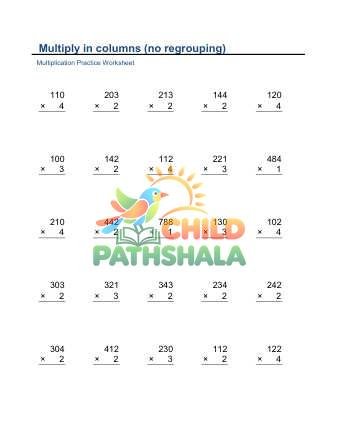
This is a 2-page pack — the thumbnail shows page 1 of 2. Words and themes pulled straight from the file include:
multiplycolumnsregroupingmultiplication
Sample exercises from this page
- Multiply in columns (no regrouping)
- Multiplication Practice Worksheet
- 110
- 203
- 213
- 144
- 120
- 100
- 142
- 112
Watch: Color by Number in action
▶ Now playing: Color by Number
📺 Dedicated Watch Page →File details & curriculum alignment
Worksheet overview & learning goals
This Grade 1 Multiplication page, Multiply Columns No Regroup C, belongs to the Multiply Columns No Regroup collection in Math. It is built for real life: one page, zero prep, free preview, and print-ready output that looks crisp on both home printers and school copiers.
Wondering if the level fits? Grade 1 (ages 6–7) is the sweet spot, and the Easy band means the page challenges without crushing. If your child stalls on item three, do it together and release the rest — that gradual handover is exactly how Multiplication confidence is built.
This page works anywhere a printer lives: classrooms, homeschool tables, tutoring sessions, libraries, and travel binders. Because it is self-contained, no answer key hunt or extra materials are needed — learning starts the moment the page lands on the desk.
- Strengthen attention stamina with a satisfying finish-the-page arc
- Strengthen calculation fluency with the Multiply Columns No Regroup problem set
- Turn screen-free time into Multiplication progress with zero setup or cleanup
- Improve accuracy and speed with short, focused Grade 1 practice sessions
- Make practice portable — prints cleanly for travel, waiting rooms, and weekends away
- Grow confidence by mastering one Multiplication skill before moving on
Included in a printable bundle
This page is part of the Multiply Columns No Regroup bundle, a 6-page printable pack covering Multiply Columns No Regroup for Grade 1. Single pages are perfect for tonight; the full pack is what you want for the week — download the whole bundle as one ZIP below and you will never scramble for tomorrow's practice again. You are looking at page 3 of 6 in this pack — it follows Multiply Columns No Regroup B and leads into Multiply Columns No Regroup D, so the difficulty steps up gradually. Working the pack in order gives the smoothest progression, though every page also stands alone.
Download full 6-page bundle (ZIP) See all pages in Multiply Columns No Regroup
Also in this bundle
Multiply Columns No Regroup AMultiply Columns No Regroup BMultiply Columns No Regroup DMultiply Columns No Regroup EMultiply Columns No Regroup F
Curriculum & skill alignment
This Grade 1 math printable targets Multiplication through the Multiply Columns No Regroup skill set, giving children the repeated, focused practice that mental math fluency demands. At the Easy stage, learners benefit most from short daily sessions of ten to fifteen minutes rather than long weekly drills, because spaced repetition moves number facts from short-term memory into lasting recall. Each problem on the page isolates one thinking step so a child can self-check line by line, and parents can spot exactly where help is needed. The layout mirrors the way math is taught in Grade 1 classrooms: clear instructions at the top, generous writing space, and problems ordered from warm-up easy to stretch challenge. Used twice a week, pages like this one compound quickly — a single term of steady practice can lift a hesitant counter into a confident problem solver. Teachers often assign this sheet as morning work or a homework add-on, while parents use it for weekend catch-up before tests. Because every problem is printed in large, high-contrast type, the page also suits learners who need extra visual clarity, and the single-page format means no stapling, no lost second sheets, and no printer drama.
At the Easy band (Grade 1, ages 6–7), the developmental milestones that matter most are pencil grip, following one- and two-step directions, and sustaining focus for ten to fifteen minutes. Children this age learn through their hands, so every traced line, circled answer, and colored shape is literally wiring the brain for later academic work. Expect wobbles: letter sizes will vary, answers will drift off baselines, and attention will wander mid-page. All of that is normal and healthy. The right response is shorter sessions, warmer praise for effort, and immediate repetition of anything that clicked — this page plus one sibling variant tomorrow will do more good than any lecture about trying harder. Watch for the milestone moments: the first fully independent row, the first self-caught mistake, the first request for another page. Each one signals readiness for slightly longer, slightly harder Multiplication work.
Step-by-step parent & teacher guide
Everything on this page is self-contained, so preparation is just printing. If your child tends to rush, fold the sheet so only one row shows at a time; if they tend to stall, do the first item with them and set a friendly timer for the rest.
- Independent practice: hand over the pencil. Stay close enough to answer questions but far enough that the child feels ownership — this is where Easy stamina is built.
- Print and preview: open the free preview below to confirm the page matches your lesson, then download or print. One copy per child, single-sided so markers never bleed onto a second activity.
- Coach from the sidelines: resist correcting mid-page and instead place a tiny dot beside items to revisit. Finishing with momentum matters more than finishing flawlessly at the Easy stage.
- Give the pencil fully to the child from item one. Even wobbly first attempts done solo teach more than perfect answers done by an adult.
- Print at 100 percent scale on Letter or A4 and keep one spare copy ready — retries happen the moment a page starts going well.
Recommended supplies
Colored pencils beat markers for detail work on this page — they sharpen fine motor control and never bleed. Keep a handheld sharpener beside the practice spot; the sharpening pause doubles as a natural thinking break.
Extension activities
- Portfolio pick: at month's end, let your child choose their favourite finished page from the bundle and explain why. The conversation reveals more than any quiz sheet.
- Colour-code review: circle the easiest answer in green and the trickiest in orange, then ask why the orange one felt harder. The explanation is the real lesson hiding inside the page.
- Variant ladder: print two sibling pages from the Multiply Columns No Regroup bundle and do one today, one in three days. Spaced repetition across variants is what converts a good session into a durable multiply columns no regroup skill.
5 Steps to Skill Mastery for this Topic
Find exact learning gaps before practicing.
Screen-free pencil-on-paper completion.
Stuck on an item? Generate 3 mirror practice sheets.
Reinforce recall with interactive games.
Record mastery and print a diploma certificate.
Where to Go Next: 3-Tier Learning Ladder
Choose the best next step tailored to how your child performed on today’s worksheet:
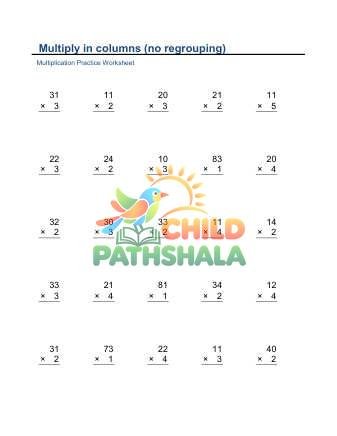
Multiply Columns No Regroup A
Grade-1Rebuilds confidence with gentler foundational numbers and visual cues.
Multiply Columns No Regroup A
Grade-1Parallel sibling practice to lock in muscle memory without memorization.

10 11 12 Times Tables B
Grade-2Advances to multi-step reasoning, higher numbers, or next grade level.
Keep practicing
Frequently asked questions
Is this multiplication worksheet free for classroom use?
Yes — printing for a full class, a co-op, or a tutor's caseload is exactly what this library is for. Preview the page first so you know what every student will receive, then print the class set in one run. If you plan a whole unit around the Multiply Columns No Regroup topic, the bundle ZIP gets you every sibling variant in a single download, which keeps week-two and week-three printing just as easy as today's.
How do I print this PDF without dark borders or cut-off edges?
School copiers behave differently from home printers: choose single-sided, normal contrast, and 100 percent scale for the cleanest class sets. If your copier darkens backgrounds, lighten the copy density one notch — the bold Multiplication lines stay crisp while gray wash disappears. Printing from a phone or tablet works fine through any PDF reader; just confirm US Letter or A4 in the print preview first. For laminated reuse, print once on cardstock, slip the sheet into a dry-erase pocket, and hand out whiteboard markers — one print serves the whole term. Whatever the machine, always run a single test copy before committing to thirty.
What age group is this printable best suited for?
A quick readiness check settles it: hand the child the page and watch the first row without helping. Smooth and confident means independent practice; hesitation means work the first two items together and then step back; total stall means swap in an easier sibling variant from the same bundle this week and revisit this one after a confidence-building page. The curriculum section above lists every Multiply Columns No Regroup the page touches, so you can match it to what your class or child is covering this month rather than guessing.
What skills does this Grade 1 worksheet build?
In report-card language, this page supports Multiplication proficiency plus work-habit goals like task completion and independent practice — phrases teachers and parents both use at conference time. Mention the specific wins you observed: finished without reminders, self-corrected an error, or explained an answer aloud. Those observations become powerful portfolio notes and concrete praise that beats generic good job stickers. Because the Multiply Columns No Regroup collection spans many variants, you can document progress across weeks with dated finished pages as evidence. Bring two or three to the next parent-teacher meeting and the conversation shifts from vague worries to a visible growth story told in your child's own handwriting.
One page today, a confident learner tomorrow. Preview Multiply Columns No Regroup C free above, print it in seconds, and keep the Multiply Columns No Regroup bundle bookmarked for the rest of the week. Bookmark the bundle page so tomorrow's print is one click away.