FREE Grade 4 (Ages 9–10) 🎯 CCSS Grade 4 / UK KS2 🇬🇧 UK: Year 4 (KS2) 🖨️ Tested for US Letter & A4 · Portrait
Balancing Scale E Worksheet for Grade 4
Balancing Scale E is a printable PDF worksheet for Grade 4 (Math › Measurement). It belongs to the Balancing Scale set and gives children one focused page of practice they can complete with a pencil, crayons, or a marker.
✏️ Practice On-Screen Download PDF Print ✨ Create Similar with AI
Resize & download
👨🏫 Parent Teaching Guide & Interactive Answer Key
Step-by-step solutions, parent teaching script, common pitfalls, and print grading rubric for Grade 4 Balancing Scale E.
“Always start with the friendly ones column on the far right! If our ones make a two-digit number like 14, the 4 stays downstairs and the 1 takes the elevator up to the tens house!”
Subtracting the smaller top digit from the larger bottom digit without regrouping (e.g. 52 - 17 calculated as 45 instead of 35). Always ask: “Do we have enough on top?”
⏱️ 3-Minute Structured Home Teaching Plan:
Why Physical Pencil Writing Builds Stronger Neural Pathways
Preview this worksheet
✍️ Draw, Trace & Practice On-Screen
Inside this PDF

This is a 2-page pack — the thumbnail shows page 1 of 2. Words and themes pulled straight from the file include:
balancingscalemixedunitsgrademeasurementmakescalesbalancecalculatingunknownweightanswers
Sample exercises from this page
- Balancing a scale (mixed units)
- Grade 4 Measurement Worksheet
- Make the scales balance by calculating the unknown weight.
- 8,000 g
- 2 kg
- ____ kg
- 848 oz
- 320 oz
- ___ lbs
- 6.5 kg
Watch: Color by Number in action
▶ Now playing: Color by Number
📺 Dedicated Watch Page →File details & curriculum alignment
Worksheet overview & learning goals
Looking for Grade 4 Math practice that actually gets finished? Balancing Scale E covers Measurement through the Balancing Scale set on a single clean page. The format is deliberately simple: clear instructions, large print, and room to write, so children spend their energy on learning instead of figuring out the worksheet.
Everything about the layout serves ages 9–10 attention spans: one skill per page, items ordered from warm-up to gentle stretch, and enough white space that the page never feels crowded. Medium learners stay engaged when success arrives early, so the opening items are designed to be winnable within the first minute.
Printing and preparation could not be simpler: open the preview, confirm the page, and print single-sided. Keep a folder of finished Measurement pages — flipping back through completed work shows children how far they have come and motivates the next session.
- Build number sense through guided Measurement practice at a Medium level
- Create a portfolio trail of dated pages that makes growth visible
- Develop mathematical reasoning by explaining each answer aloud
- Support mixed-ability groups — fast finishers simply move on to sibling pages
- Connect classroom math lessons to independent homework practice
- Build test readiness through calm, low-stakes Measurement repetition
Included in a printable bundle
This page is part of the Balancing Scale bundle, a 4-page printable pack covering Balancing Scale for Grade 4. Single pages are perfect for tonight; the full pack is what you want for the week — download the whole bundle as one ZIP below and you will never scramble for tomorrow's practice again. You are looking at page 3 of 4 in this pack — it follows Balancing Scale C and leads into Balancing Scale F, so the difficulty steps up gradually. Working the pack in order gives the smoothest progression, though every page also stands alone.
Download full 4-page bundle (ZIP) See all pages in Balancing Scale
Also in this bundle
Balancing Scale ABalancing Scale CBalancing Scale F
Curriculum & skill alignment
Parents often ask where Grade 4 children actually get stuck in Measurement — and this page is built to reveal exactly that. Because every item isolates one balancing scale decision, a quick scan of the finished sheet shows the error pattern instantly: miscounts cluster at the top mean rushing, while errors scattered throughout usually signal a shaky method rather than carelessness. That diagnosis is gold, because the fix for rushing (slow down, check each line) differs completely from the fix for method gaps (re-teach with objects or drawings). Work the first row together and narrate your thinking; children imitate adult reasoning far more than adult instructions. Then let the page do its quiet work: ten minutes of independent Medium practice, followed by a two-minute review where the child explains one solved item back to you. Keep finished sheets for a month and compare early and late attempts side by side — the visible narrowing of error patterns is the clearest evidence that Measurement fluency is taking root, and it motivates better than any reward chart.
More Medium-band frontiers opening now: tackling word problems that need two operations, writing full paragraphs with topic sentences, and managing a weekly homework rhythm with minimal reminders. This is the season for study skills in disguise — checking work, using an eraser thoughtfully rather than catastrophically, and asking precise questions instead of announcing confusion. Introduce a simple self-score: after each Measurement page, your child predicts their mark before you check together, which trains the metacognition strong students rely on. Friendly competition with their own past scores (never siblings) keeps motivation healthy. Two balancing scale variants a week at this band, reviewed properly, will quietly move a Grade 4 learner from the middle of the pack toward its confident front.
Step-by-step parent & teacher guide
The only real preparation is a pencil sharpener and a flat surface. Print the page, sit within earshot, and let your child read the instructions aloud once — that thirty-second ritual quietly checks comprehension and settles wiggles before work begins.
- Read the instructions aloud once together, then have your child re-read them silently before starting; the double pass prevents half the usual 'what do I do?' interruptions.
- Give the pencil fully to the child from item one. Even wobbly first attempts done solo teach more than perfect answers done by an adult.
- Time-box the session to twelve minutes. The page is designed to fit, and ending while energy is high is what makes children ask for the next one.
- Print and preview: open the free preview below to confirm the page matches your lesson, then download or print. One copy per child, single-sided so markers never bleed onto a second activity.
- Narrate the thinking: ask your child to say each step out loud before writing it. Spoken reasoning catches slips before they reach the page.
Recommended supplies
Colored pencils beat markers for detail work on this page — they sharpen fine motor control and never bleed. Keep a handheld sharpener beside the practice spot; the sharpening pause doubles as a natural thinking break.
Extension activities
- Variant ladder: print two sibling pages from the Balancing Scale bundle and do one today, one in three days. Spaced repetition across variants is what converts a good session into a durable balancing scale skill.
- Colour-code review: circle the easiest answer in green and the trickiest in orange, then ask why the orange one felt harder. The explanation is the real lesson hiding inside the page.
- Count and describe: have the child count objects, shapes, or answers on the page, then describe them — color, size, position. This ten-second extension turns any Math page into oral-language practice.
5 Steps to Skill Mastery for this Topic
Find exact learning gaps before practicing.
Screen-free pencil-on-paper completion.
Stuck on an item? Generate 3 mirror practice sheets.
Reinforce recall with interactive games.
Record mastery and print a diploma certificate.
Where to Go Next: 3-Tier Learning Ladder
Choose the best next step tailored to how your child performed on today’s worksheet:
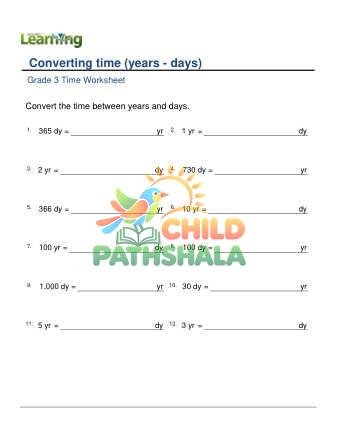
Convert Time Years Days
Grade-3Rebuilds confidence with gentler foundational numbers and visual cues.

Balancing Scale C
Grade-4Parallel sibling practice to lock in muscle memory without memorization.

Advances to multi-step reasoning, higher numbers, or next grade level.
Keep practicing
Frequently asked questions
Is this measurement worksheet free for classroom use?
Absolutely — and that includes homeschool co-ops, tutoring centers, and after-school programs, not just traditional classrooms. There is no seat limit and no licensing paperwork for normal educational use: preview, print, and teach. The one request we make is simple — link colleagues to this page instead of emailing the file around, so everyone prints the current version. Heavy users running hundreds of copies a month should use draft mode and the bundle ZIP to keep printing budgets sane. If your school needs documentation for approved-resource lists, this page's curriculum section above describes the skill alignment in administrator-friendly language.
How do I print this PDF without dark borders or cut-off edges?
Open the free preview first to confirm the layout, then print at 100 percent scale (sometimes labeled Actual Size) on US Letter or A4 — the page is designed for both. If edges clip, switch the printer dialog from Borderless to Normal margins, which restores the safe zone most home printers need. For daily classroom runs, draft or grayscale mode saves ink with no loss of clarity, since all instructions use high-contrast type. Printing single-sided is best when children use markers, as ink can ghost through thin paper onto whatever waits beneath. If colors print too dark on your machine, choose Grayscale or Draft mode; the high-contrast layout stays fully legible while using a fraction of the ink.
What age group is this printable best suited for?
This page targets Grade 4 (ages 9–10) at a Medium level. Children at the younger end of that range should do the first items with an adult, then continue solo once the pattern clicks; older or advanced children can treat it as quick independent practice or warm-up. If the page feels too easy, move up within the same Measurement topic rather than skipping ahead a grade — depth beats acceleration at this stage. If it feels hard, pair it with an easier sibling variant from the same bundle and alternate days. Either way, ten to fifteen focused minutes beats a tired half hour. Watch the first session closely: if your child finishes quickly and accurately, add the next sibling variant the same week; if they stall, revisit the worked example together and try again in a day or two.
What skills does this Grade 4 worksheet build?
In report-card language, this page supports Measurement proficiency plus work-habit goals like task completion and independent practice — phrases teachers and parents both use at conference time. Mention the specific wins you observed: finished without reminders, self-corrected an error, or explained an answer aloud. Those observations become powerful portfolio notes and concrete praise that beats generic good job stickers. Because the Balancing Scale collection spans many variants, you can document progress across weeks with dated finished pages as evidence. Bring two or three to the next parent-teacher meeting and the conversation shifts from vague worries to a visible growth story told in your child's own handwriting.
Ten focused minutes is the whole commitment: preview Balancing Scale E above, print, and hand over the pencil. The finished page joins the folder, the folder becomes the portfolio, and the portfolio becomes proof of how far Grade 4 practice has come.