Home › Blog › Parents & Teachers › Why Giving Children Answers Through Technology Can Reduce In
Why Giving Children Answers Through Technology Can Reduce Independent Thinking: Search Autopilot, Memory Offloading, and The Google Effect
In an era of voice-activated smart speakers, search engines, and automated homework helpers, children have instantaneous access to the sum of human knowledge.


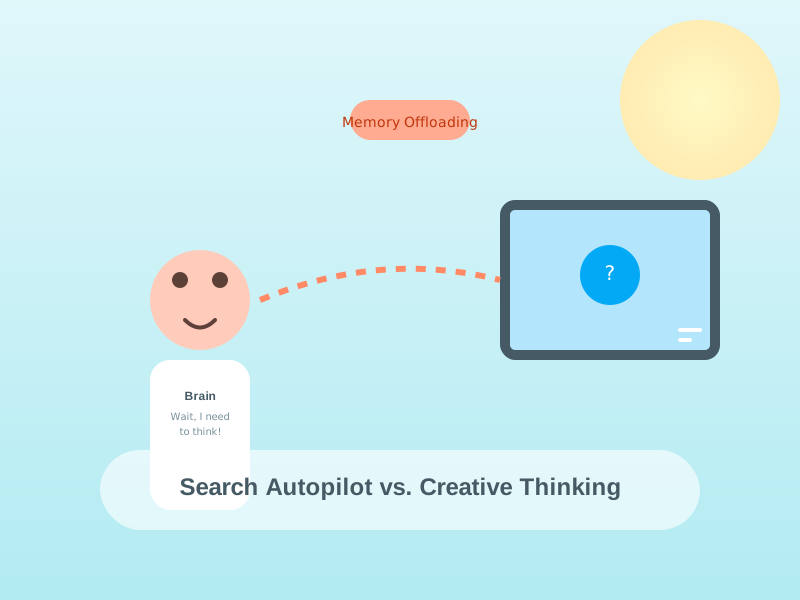
In an era of voice-activated smart speakers, search engines, and automated homework helpers, children have instantaneous access to the sum of human knowledge. The moment a child asks "What is the capital of Peru?" or "What is 15% of 80?", parents often prompt: "Just ask Alexa!" or "Google it!"
While instant information access is convenient, cognitive psychologists have documented a concerning phenomenon known as The Google Effect (Digital Amnesia): when the brain knows that information is readily accessible online, it intentionally offloads memory storage, fails to build interconnected mental schemas, and weakens deep analytical reasoning.


1. The Cognitive Offloading Architecture
THE DIGITAL AMNESIA & COGNITIVE OFFLOADING SPIRAL
When setting up our home study corner, we set out a full box of 48 crayons. Within five minutes, thirty-six crayons were rolling across the floor and our preschooler was overwhelmed. Now, before any activity, we place exactly three crayons on the wooden tray. A clear desk creates a calm, focused mind.
2. Why Instant Answers Harm Developing Minds
1. Destroys the "Epistemic Curiosity" Gap
Curiosity is fueled by sitting with a question, wondering, hypothesizing, and debating possibilities. Providing an instant Google answer closes the curiosity gap in one second, terminating deep inquiry.
2. Prevents Schema Formation in Long-Term Memory
Critical thinking is not a generic skill; it requires a rich, interconnected lattice of domain facts stored in long-term memory. If children store all knowledge in external cloud servers, they lack the raw cognitive material required for creative synthesis.
3. Weakens Cognitive Stamina and Patience
When every answer is delivered instantaneously, children develop zero tolerance for ambiguity, slow problem solving, or complex multi-step reasoning.
3. Instant Search Autopilot vs Deep Inquiry Protocols
| Search Autopilot Habit (Harmful) | Deep Inquiry Protocol (Transformative) | Cognitive Advantage |
|---|---|---|
| "Ask Alexa right away" | "What do you hypothesize the answer might be? Why?" | Stimulates deductive logic and prior knowledge retrieval |
| Googling math solutions instantly | Working through the problem with visual diagrams first | Builds working memory stamina and problem-solving grit |
| Reading the first search snippet as absolute truth | Comparing two different encyclopedia sources critically | Develops source evaluation and media literacy |
| Outsourcing all factual memory to devices | Memorizing core mathematical, historical, and geographical schemas | Provides mental lattice for advanced synthesis |
4. The "Wonder Before You Search" Protocol
When your child asks a factual or conceptual question:
- The 60-Second Wonder Window: Do not touch a device. Ask: "What are three possible clues? What makes sense based on what we already know?"
- Debate and Hypothesize: Formulate two competing family hypotheses.
- Strategic Search & Verification: Search together, analyze the top 3 authoritative sources, and confirm which hypothesis was correct.
5-Day Inquiry Cultivation Blueprint
- Monday (The Smart Speaker Ban During Study): Mute or unplug voice assistants in the study area during homework hours.
- Tuesday (The Hypothesis Dinner Game): Ask a curious science question at dinner; have everyone debate their hypothesis before checking.
- Wednesday (The Physical Dictionary / Atlas Hunt): Look up a tricky word or geographical location in a real printed book.
- Thursday (The "Why" Chain Reaction): When a fact is found, ask: "Why does that happen?" three times to explore root causes.
- Friday (The Living Room Science Debate): Debate a fascinating historical or scientific mystery together as a family.
Independent Inquiry Diagnostic Rubric
- Hypothesis Formulation: Does the child attempt to reason and hypothesize before immediately reaching for a device?
- Schema Density: Does the child retain and recall foundational knowledge without needing instant search verification?
- Critical Stamina: Can the child sit with an unsolved question for several minutes without frustration?
Epistemic Curiosity and Memory Architecture Protocols
- The 60-Second Wonder Window: Require children to hypothesize and debate possible answers before searching online.
- Schema Density Preservation: Build permanent mental frameworks in long-term memory to support critical reasoning.
- Physical Reference Navigation: Use physical dictionaries, atlases, and printed encyclopedias to build spatial scanning.
- Root-Cause Inquiry: Ask "Why does that happen?" three times to explore deep causal connections beneath facts.
Independent Inquiry Diagnostic Checklist
- Hypothesis Formulation: Does the child attempt to reason and speculate before reaching for a search engine?
- Mental Schema Recall: Can the child recall and use foundational facts without needing digital verification?
- Inquiry Stamina: Can the child sit with an unsolved question for several minutes with curious engagement?
Frequently Asked Questions
Q: Isn't memorizing facts obsolete now that we have search engines?
Absolutely not! Cognitive science proves that you cannot think critically about a subject without having facts stored in your long-term memory. Working memory uses stored schemas to make creative connections.
Q: What should I do when my child asks a question I don't know the answer to?
Celebrate it! Say: "What a fantastic question! I don't know either. Let's think about how we can investigate this together."
Q: Is using a physical atlas or encyclopedia better than Wikipedia?
Physical reference books require spatial scanning, alphabetical sorting, and cross-referencing, which builds superior spatial and organizational cognition.
Key Takeaways
- The Google Effect causes cognitive offloading: when information is instant, the brain fails to store permanent mental schemas.
- Critical thinking and creativity require a rich foundation of facts stored in long-term memory.
- Implement the "Wonder Before You Search" rule: hypothesize, debate, and reason before opening a search engine.
📑 Practice Offline: Matching Printable Worksheets


activitieslearningparents
Watch Parents & Teachers in action
▶ Now playing: Child Pathshala Printables
📺 Dedicated Watch Page →Parent favorites from the store
View all →


Apply during checkout for instant savings. Shop all bundles →
Looking for Printable Worksheets & Words?
Turn today's ideas into practice — 14,900+ free worksheets by grade, subject and skill, plus an illustrated 30,000-word dictionary.
Keep reading
 Parents & Teachers
Free Grade 3 Worksheets: High-Quality Curated Printables for Upper Elementary Success
Anand Kumar
 Parents & Teachers
How Too Much Homework Can Reduce a Child's Motivation: The Law of Diminishing Returns, Burnout, and Family Time Preservation
Anand Kumar
 Parents & Teachers
Grade 6 Habitats and Adaptations: Structural, Behavioral, Physiological, and Extreme Biomes
Anand Kumar
 Parents & Teachers
Grade 6 Worksheets: Navigating the Middle School Transition with Rigorous, Multi-Disciplinary Printables
Anand Kumar
Get New Learning Activities & Printables
One short email a week — no spam, unsubscribe anytime.