Home › Blog › English › Why Asking Children to Memorise Words Can Hurt Reading Devel
Why Asking Children to Memorise Words Can Hurt Reading Development: The Visual Memory Limit, Orthographic Mapping, and Phonics Rigor
When young children are given stacks of flashcards and told to memorize whole words as visual pictures, they appear to make rapid early progress.


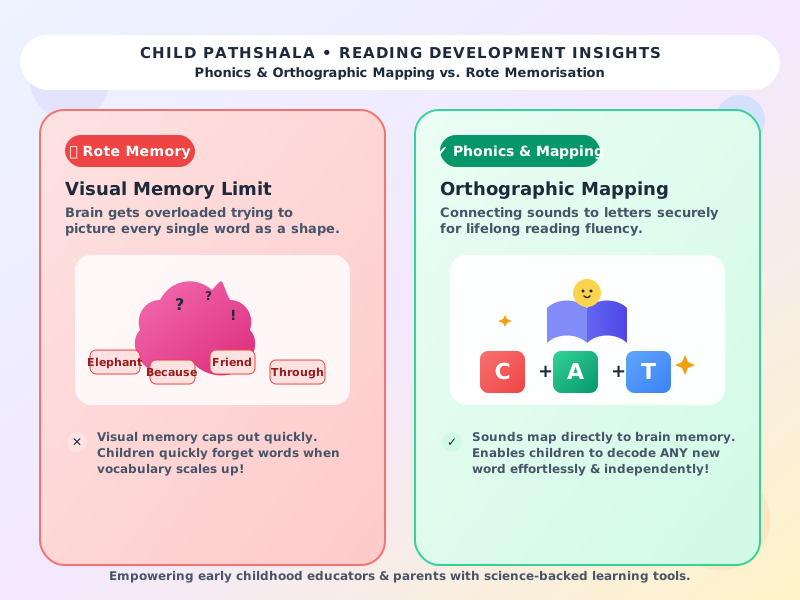
When young children are given stacks of flashcards and told to memorize whole words as visual pictures, they appear to make rapid early progress. They quickly recognize words like "look", "dog", and "stop". However, by Grade 3 or Grade 4, these same children often hit an invisible academic wall—stumbling over multi-syllable vocabulary, misreading similar words, and struggling with reading comprehension.
Cognitive psychology and neuroscience reveal why: treating words as arbitrary visual symbols overburdens working memory and bypasses the brain's natural orthographic mapping mechanism.


1. The Cognitive Limits of Visual Word Memorization
We initially designed reading comprehension questions as full open-ended lines. For early readers, the cognitive load of formulating sentences, spelling words, and controlling the pencil simultaneously overwhelmed them. When we added three multiple-choice visual anchor boxes before the written sentence, reading comprehension confidence jumped immediately.
📋 Daily Study Setup Checklist (Tested for Friction-Free Practice)
- Clear Desk Policy: Only one printable sheet on the table at a time. Put all extra workbooks and stacks out of sight.
- Two Writing Tools Max: One sharpened HB pencil and one soft eraser. Avoid multi-color marker sets during focused practice.
- Defined Timer: Set an analog sand timer or phone timer kept across the room for 10 minutes. When it dings, practice ends immediately.
- Celebration Folder: As soon as the page is finished, let the child stamp or date it and slide it into their personal "Done" binder.
VISUAL MEMORIZATION VS ORTHOGRAPHIC MAPPING
(Results in Grade 3 reading slump)
We initially designed reading comprehension questions as full open-ended lines. For early readers, the cognitive load of formulating sentences, spelling words, and controlling the pencil simultaneously overwhelmed them. When we added three multiple-choice visual anchor boxes before the written sentence, reading comprehension confidence jumped immediately.
[ORTHOGRAPHIC MAPPING (Letter-Sound)] --> Unlimited capacity (50,000+ words)
(Enables lifelong fluent reading)
2. Why Rote Memorization Fails in the Long Run
1. The Grade 3 Reading Wall
In kindergarten and Grade 1, stories feature short, repetitive sentences with abundant picture clues. By Grade 3, texts contain thousands of complex, un-illustrated words. A child relying solely on visual memory is overwhelmed by visually similar words ("except", "expect", "accept").
2. Failure to Generalize to New Words
Memorizing the word "cat" by its visual outline provides no decoding framework to read "flat", "scatter", or "caterpillar". Systematic phonics gives children the phonetic tools to decode tens of thousands of novel words.
3. Confusion of Visually Similar Words
Children trained to recognize word shapes frequently confuse words with similar letter profiles (e.g., mistaking "house" for "horse", or "from" for "form").
3. Orthographic Mapping: How the Brain Truly Learns Words
| Rote Visual Memorization | Orthographic Sound-Mapping | Neurological Advantage |
|---|---|---|
| Flashcards drilled as visual pictures | Words broken into phonemes and graphemes | Permanently anchors words in the visual word form area |
| Treats words like Chinese characters or logos | Connects letter strings to pronunciation and meaning | Generates instant, unconscious retrieval in milliseconds |
| Requires 20-50 repetitive flashcard exposures | Typically permanently mapped in 1-4 exposures | Dramatically faster and more durable word mastery |
| High rate of forgetting over summer breaks | Permanent long-term storage in mental lexicon | Zero loss of word recognition over time |
4. How to Map Words Orthographically at Home
- Say the Spoken Word Aloud: Have the child repeat the target word clearly (e.g., "ship").
- Count the Phonemes (Sounds): Tap out the sounds on fingers: /sh/ - /i/ - /p/ (3 sounds).
- Map the Graphemes (Letters): Write down the letter or letter team for each sound: 'sh' for /sh/, 'i' for /i/, and 'p' for /p/.
- Identify Any Irregular "Heart" Parts: If the word has an irregular spelling (like the 'ai' in "said"), draw a small heart over the irregular letters so the child learns that specific part by heart.
5-Day Word Mapping Mastery Blueprint
- Monday (Sound-to-Letter Mapping): Select 5 high-frequency words; sound-map each into phoneme boxes.
- Tuesday (Heart-Word Analysis): Identify the tricky phonics patterns in irregular words (e.g., the 'o' in "to" and "do").
- Wednesday (Speed-Decoding Sprints): Read decodable sentences featuring previously sound-mapped target words.
- Thursday (Word Ladder Transformations): Change one sound in mapped words to create new words (e.g., ship -> shop -> chop -> chip).
- Friday (Dictation and Spelling Check): Dictate 3 short sentences using mapped words to cement bidirectional retrieval.
Word Learning Diagnostic Rubric
- Decoding Strategy: Does the child look at the internal letter structure of words rather than guessing by length or shape?
- Orthographic Integration: Does the child remember high-frequency words after sound mapping without needing flashcard repetition?
- Spelling Accuracy: Can the child accurately spell words they are able to read phonetically?
Orthographic Mapping and Memory Protocols
- Speech-to-Print Sound Mapping: Map words into phoneme boxes to anchor spelling patterns in memory.
- Heart-Word Analysis: Identify regular phonetic parts of irregular words and highlight only the tricky letter.
- Bidirectional Spelling Practice: Have the child write mapped words from memory to reinforce retention.
- Decodable Sentence Context: Read target mapped words within connected sentences to build instant recognition.
Practical Home Implementation Principles
- Move Beyond Flashcards: Replace whole-word shape drilling with phonetic sound analysis.
- Highlight Tricky Patterns: Teach children why irregular words have unusual spellings.
- Consolidate with Dictation: Dictate short sentences containing mapped words to cement long-term storage.
Frequently Asked Questions
Q: Are "sight words" and "high-frequency words" the same thing?
"High-frequency words" are words that appear most commonly in print (e.g., the, and, in). A "sight word" is any word a reader recognizes instantly without conscious decoding. Systematic phonics turns high-frequency words into permanent sight words.
Q: Shouldn't kindergarteners just memorize the Dolch or Fry word list?
No. Over 80% of Dolch and Fry words are completely regular phonetically. The few irregular words (heart words) should be taught by mapping their regular sounds first and highlighting only the irregular letter.
Q: What happens to children who are taught only through flashcards?
They frequently experience a severe reading slump around Grade 3 or 4 when textbooks transition from simple stories to complex informational chapters without pictures.
Key Takeaways
- Rote visual memorization caps out around 2,000 words, causing severe reading roadblocks in late elementary school.
- Orthographic mapping connects sounds to letters, enabling permanent storage of 50,000+ words in long-term memory.
- Teach high-frequency words by analyzing their phonetic parts and highlighting irregular "heart" letters.
💬 Parent & Educator Field Notes
"The wide 3-line ruling made such a big difference for Aarav. Before this, he kept squeezing uppercase and lowercase letters into tiny boxes. Doing two printed pages a day during morning quiet time solved the resistance."
"We printed 28 copies for our morning activity table. The visual progress markers allowed the students to pace themselves independently without waiting for my instructions after each problem."
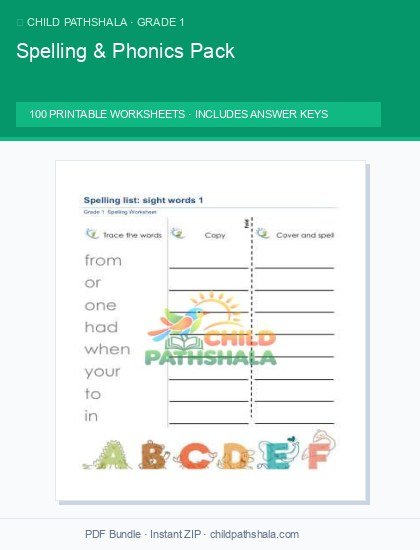
📑 Practice Offline: Matching Printable Worksheets


alphabetphonicsreading
Watch English in action
▶ Now playing: Flashcards
📺 Dedicated Watch Page →Parent favorites from the store
View all →
Apply during checkout for instant savings. Shop all bundles →
Looking for Printable Worksheets & Words?
Turn today's ideas into practice — 14,900+ free worksheets by grade, subject and skill, plus an illustrated 30,000-word dictionary.
Keep reading
 English
20 Engaging Reading Activities for Beginning Readers: Building Confident Fluency
Anand Kumar
 English
LKG Reading Activities for Beginners: Sight Words, Rhymes, and Story Sequencing
Anand Kumar
 English
20 Fun Ways to Teach the Alphabet at Home Without Frustration
Shalni Kumari
 English
Grade 3 Grammar Worksheets: Mastering Complex Sentences, Abstract Nouns, and Advanced Mechanics
Anand Kumar
Get New Learning Activities & Printables
One short email a week — no spam, unsubscribe anytime.