Home › Blog › Parents & Teachers › Should You Make a Preschool Child Sit and Study for Long Hou
Should You Make a Preschool Child Sit and Study for Long Hours?: Attention Biology, Movement Needs, and Sensory Fatigue
In a competitive culture that prizes early academic achievement, some parents attempt to make 3- and 4-year-olds sit at a desk for one or two hours daily to complete worksheets.


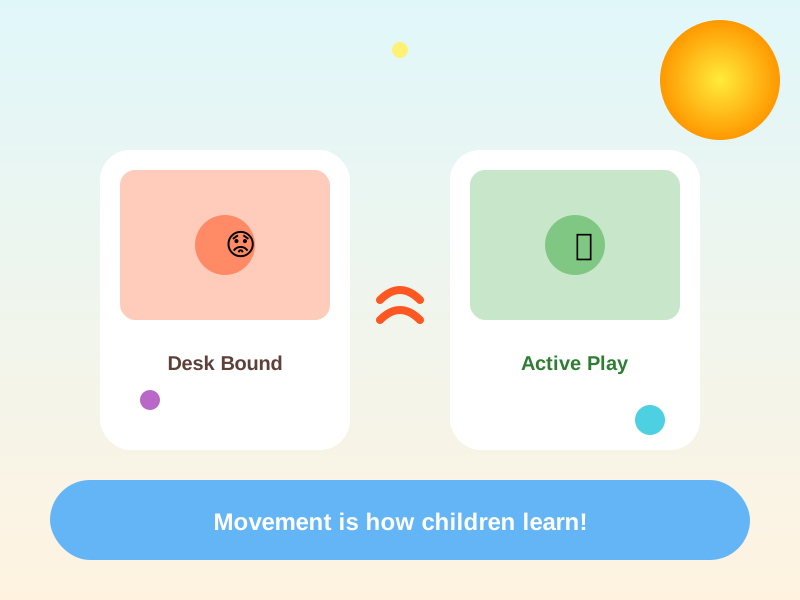
In a competitive culture that prizes early academic achievement, some parents attempt to make 3- and 4-year-olds sit at a desk for one or two hours daily to complete worksheets. Cognitive neuroscience and developmental pediatrics are unequivocal: forcing preschool children to sit and study for prolonged periods is biologically harmful, induces sensory fatigue, and damages long-term academic motivation.
Understanding the neurobiology of early attention and integrating movement-rich micro-learning intervals ensures optimal cognitive development.

1. The Neurobiology of Early Attention Spans
BIOLOGICAL ATTENTION CEILING FORMULA
$$\text{Preschool Maximum Focus} = \text{Age} \times (2 \text{ to } 3)\text{ Minutes}$$
- Age 3: 6 to 9 Minutes maximum focused attention.
- Age 4: 8 to 12 Minutes maximum focused attention.
- Age 5: 10 to 15 Minutes maximum focused attention.
*(Demanding a 4-year-old sit for 60 minutes exceeds biological capacity by 500%!)*When setting up our home study corner, we set out a full box of 48 crayons. Within five minutes, thirty-six crayons were rolling across the floor and our preschooler was overwhelmed. Now, before any activity, we place exactly three crayons on the wooden tray. A clear desk creates a calm, focused mind.
2. Why Prolonged Sitting Disrupts the Developing Brain
| Physiological System | Biological Need | Consequence of Forced Prolonged Sitting |
|---|---|---|
| Vestibular System | Requires spinning, swinging, and balance movement to calibrate inner ear | Restlessness, physical wiggling, and inability to maintain upright posture |
| Prefrontal Cortex | Rapid glucose and oxygen consumption in short bursts | Brain fatigue sets in; child enters daydreaming or irritable tantrums |
| Proprioceptive Sense | Needs muscle resistance (pushing, climbing, lifting) | Hand cramping, sensory overload, and poor body awareness |
| Ocular Muscles | Needs 3D depth shifting and natural daylight exposure | Ocular fatigue, dry eyes, and compromised visual convergence |
3. The Power of "Micro-Learning" Bursts for Early Learners
Replace long study blocks with 5-to-10 minute play-embedded learning bursts:
THE MICRO-LEARNING DAY (EXAMPLE FOR A 4-YEAR-OLD)
- 9:00 AM (8 Min): Count 10 stairs while hopping down to breakfast.
- 11:30 AM (10 Min): Read an interactive rhyming storybook before snack.
- 2:00 PM (10 Min): Form playdough letters in sensory trays during creative time.
- 4:30 PM (15 Min): Outdoor nature scavenger hunt collecting 5 leaves and 5 stones.
Total Dedicated Learning Time = 43 Minutes (Distributed with ZERO tears or friction!).
4. Movement-Integrated Learning Games for Preschoolers
KINETIC LEARNING GAME RECIPES
1. Number Line Hopscotch: Jump along a numbered chalk track on the driveway, calling out numbers.
2. Alphabet Beanbag Toss: Toss beanbags onto colored letter floor mats, shouting the letter sound.
3. Animal Movement Sound Safari: Bear crawl to the letter /b/; frog hop to the letter /f/.
4. Simon Says Prepositions: "Simon says crawl UNDER the table; Simon says stand ON the mat."
5. Early Study Fatigue Diagnostic Checklist
- Physical Signs of Fatigue: Does the child rub eyes, lay head on desk, or fidget aggressively after 10 minutes?
- Emotional Escalation: Does study time consistently end in crying, whining, or parental anger?
- Outdoor Movement Balance: Does the child spend at least twice as much time playing outdoors as sitting indoors?
6. Key Takeaways
- Respect Attention Ceilings: Keep preschool learning sessions under 10 to 15 minutes.
- Integrate Physical Movement: Movement activates the vestibular system, sharpening focus.
- Distribute Throughout the Day: Short micro-bursts yield far superior retention than long study blocks.
Preschool Attention and Energy Regulation Protocols
- The 10-Minute Focus Limit: Design early learning moments around short 5-to-10 minute interactive bursts.
- Kinesthetic Brain Breaks: Insert 3-minute dance, stretching, or animal-walk breaks between activities.
- Self-Directed Play Stamina: nurture long periods of uninterrupted imaginative play with open-ended toys.
- Visual Schedule Clarity: Use pictorial daily cards to provide predictable, reassuring structure.
Practical Home Implementation Principles
- Avoid Marathon Study Blocks: Preschoolers learn through frequent short interactions rather than long study sessions.
- Watch for Fatigue Cues: End learning activities gracefully when the child shows restlessness or eye rubbing.
- Balance Quiet and Active Times: Alternate seated storytime with active gross-motor play.
5-Day Preschool Focus and Energy Blueprint
A balanced daily schedule honoring preschool biological attention spans:
- Monday (10-Minute Focus Sprints): Engage in a 7-minute targeted puzzle or building challenge, followed by active movement.
- Tuesday (Kinesthetic Animal Brain Breaks): Frog jump, bear crawl, and crab walk across the living room between quiet activities.
- Wednesday (Audiobook and Puppet Listening): Listen to a short 5-minute audio story while cuddling with a stuffed animal.
- Thursday (Sensory Water Bin Calming): Spend 15 minutes pouring water through funnels and strainers to soothe sensory overload.
- Friday (Family Dance Celebration): Conclude the week with a joyful 10-minute freeze-dance game to build inhibitory impulse control.
Attention Health Diagnostic Rubric
- Activity Pacing: Are sedentary table tasks limited to the child's age in minutes multiplied by 2-3?
- Movement Integration: Are physical brain breaks embedded seamlessly between quiet tasks?
- Stress-Free Transitions: Do clear visual or musical cues signal the end of one activity and start of another?
Frequently Asked Questions
Q: What should I do if my preschooler's school assigns 30 minutes of daily homework?
Communicate with the preschool director or teacher. Share that you are completing 10 minutes of interactive reading and physical counting games at home, and advocate for developmentally appropriate play-based homework policies.
Q: How can I tell if my child is tired or just being defiant?
In young children, fatigue and sensory overload look identical to defiance. Yawning, hyperactivity, clumsiness, and emotional crying are physiological signals that the brain needs water, food, movement, or sleep.
📑 Practice Offline: Matching Printable Worksheets


activitieslearningparents
Watch Parents & Teachers in action
▶ Now playing: Busy Books
📺 Dedicated Watch Page →Parent favorites from the store
View all →


Apply during checkout for instant savings. Shop all bundles →
Looking for Printable Worksheets & Words?
Turn today's ideas into practice — 14,900+ free worksheets by grade, subject and skill, plus an illustrated 30,000-word dictionary.
Keep reading
 Parents & Teachers
Free Grade 3 Worksheets: High-Quality Curated Printables for Upper Elementary Success
Anand Kumar
 Parents & Teachers
How Too Much Homework Can Reduce a Child's Motivation: The Law of Diminishing Returns, Burnout, and Family Time Preservation
Anand Kumar
 Parents & Teachers
Grade 6 Habitats and Adaptations: Structural, Behavioral, Physiological, and Extreme Biomes
Anand Kumar
 Parents & Teachers
Grade 6 Worksheets: Navigating the Middle School Transition with Rigorous, Multi-Disciplinary Printables
Anand Kumar
Get New Learning Activities & Printables
One short email a week — no spam, unsubscribe anytime.