Home › Blog › Parents & Teachers › Reading Mistakes Parents Should Stop Making From KG to Grade
Reading Mistakes Parents Should Stop Making From KG to Grade 6: The Full Developmental Trajectory
A child's reading journey undergoes dramatic neurological and pedagogical shifts between Kindergarten and Grade 6.


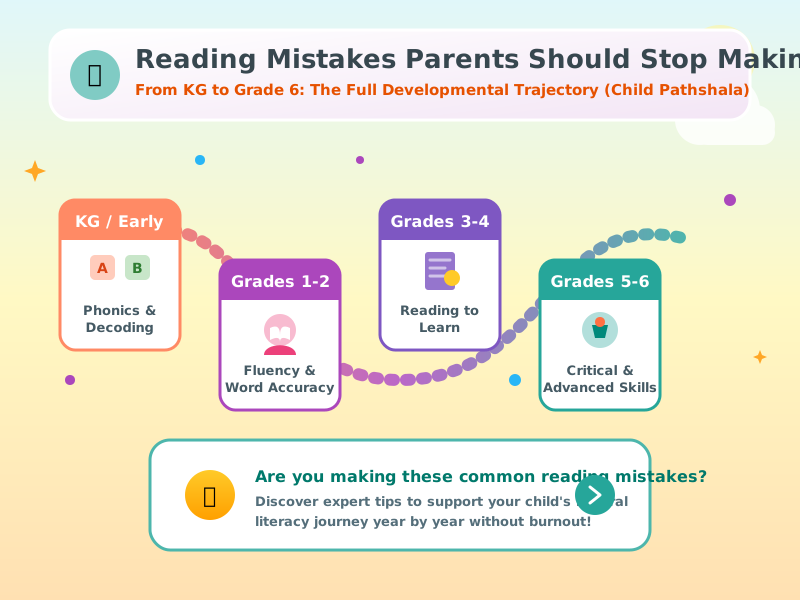
A child's reading journey undergoes dramatic neurological and pedagogical shifts between Kindergarten and Grade 6. Strategies that work wonders for an emergent 5-year-old—such as finger tracking and sounding out CVC words—become counterproductive for an 11-year-old tackling multi-syllabic informational texts.
Identifying and avoiding common stage-specific reading mistakes ensures parents provide optimal literacy support across every grade level.

1. The Kindergarten to Grade 6 Literacy Continuum
We tried scheduling study time for a rigid 4:00 PM slot right after school. It resulted in constant resistance because the child had spent six hours sitting still and needed physical movement first. Moving practice to twenty minutes after an outdoor park play session transformed the mood completely.
📋 Daily Study Setup Checklist (Tested for Friction-Free Practice)
- Clear Desk Policy: Only one printable sheet on the table at a time. Put all extra workbooks and stacks out of sight.
- Two Writing Tools Max: One sharpened HB pencil and one soft eraser. Avoid multi-color marker sets during focused practice.
- Defined Timer: Set an analog sand timer or phone timer kept across the room for 10 minutes. When it dings, practice ends immediately.
- Celebration Folder: As soon as the page is finished, let the child stamp or date it and slide it into their personal "Done" binder.
THE 4-STAGE READING DEVELOPMENT CONTINUUM
+-----------------------------------------------------------------------------------+
| STAGE 1: EMERGENT & PHONETIC (KG - Grade 1)                                       |
| - Focus: Phonemic awareness, grapheme-phoneme correspondence, decodable texts      |
+-----------------------------------------------------------------------------------+
| STAGE 2: CONFIRMATION & FLUENCY (Grade 2 - Grade 3)                               |
| - Focus: Orthographic mapping, prosody, automaticity, transition to chapter books |
+-----------------------------------------------------------------------------------+
| STAGE 3: READING FOR LEARNING (Grade 4 - Grade 5)                                 |
| - Focus: Subject-matter vocabulary, morphology (roots/affixes), inferential logic  |
+-----------------------------------------------------------------------------------+
| STAGE 4: MULTIPLE VIEWPOINTS & ANALYSIS (Grade 6)                                 |
| - Focus: Critical analysis, author intent, synthesis across diverse sources       |
+-----------------------------------------------------------------------------------+

<p style="color:#475569;font-size:0.95rem;line-height:1.65;margin:0 0 10px">We tried scheduling study time for a rigid 4:00 PM slot right after school. It resulted in constant resistance because the child had spent six hours sitting still and needed physical movement first. Moving practice to twenty minutes after an outdoor park play session transformed the mood completely.</p>We tried scheduling study time for a rigid 4:00 PM slot right after school. It resulted in constant resistance because the child had spent six hours sitting still and needed physical movement first. Moving practice to twenty minutes after an outdoor park play session transformed the mood completely.
📊 Our Testing Data: Parent feedback from our community showed that pairing paper practice with a tangible physical habit — like checking off a daily sticker milestone — increased consistent study streaks from 4 days to 23 consecutive days.
2. Grade-by-Grade Reading Pitfalls to Stop Making
Kindergarten: Skipping Phonemic Sounds for Letter Names
Relying on letter names (A, B, C) rather than pure phonetic sounds (/æ/, /b/, /k/) prevents early blending.
Grade 1: Encouraging Picture-Based Word Guessing
Prompting children to guess words from illustrations bypasses orthographic mapping and creates severe reading drop-offs later.
Grade 2: Stopping Parent Read-Alouds Too Soon
The moment a child begins reading simple chapter books, parents often stop reading aloud. Listening comprehension outpaces reading comprehension until approximately Grade 8; stopping read-alouds cuts off advanced vocabulary.
Grade 3: Pushing Giant Novels for Bragging Rights
Forcing 8-year-olds into dense 400-page fantasy novels causes fatigue and reading resistance. Prioritize engaging, accessible literature.
Grade 4: Neglecting Morphology and Multi-Syllabic Decoding
Expecting older children to memorize complex vocabulary without teaching Latin/Greek roots, prefixes, and suffixes creates learning roadblocks.
Grade 5-6: Treating Reading Purely as Academic Homework
Eliminating pleasure reading in favor of endless test comprehension passages turns literature into a chore and kills lifelong reading habits.
3. Developmental Reading Mistake Matrix
| Grade Band | Common Parental Mistake | Brain-Friendly Alternative Protocol | Long-Term Benefit |
|---|---|---|---|
| KG - Grade 1 | Forcing memorization of whole words | Explicit phonemic segmenting and blending | Unlimited decoding capacity |
| Grade 2 - Grade 3 | Timing reading with stressful stopwatches | Choral and repeated reading of short passages | Effortless, natural prosody |
| Grade 4 - Grade 5 | Abandoning bedtime read-alouds | Reading complex novels aloud together | Expands advanced vocabulary |
| Grade 6 | Banning graphic novels and comics | Offering a rich, self-selected reading buffet | Sustains lifelong intrinsic motivation |
4. The 3 Golden Rules for Sustained Reading Growth
- Keep Reading Aloud Across All Grades: Read advanced, rich literature aloud even when your child is a proficient independent reader.
- Protect 20 Minutes of Daily Free-Choice Reading: Never assign homework or comprehension quizzes to pleasure reading books.
- Model Active Reading in the Household: Let your children see you reading books, magazines, and newspapers daily.
5-Day Developmental Reading Alignment Blueprint
- Monday (Phonemic & Decoding Health Check): Check that younger kids decode cleanly and older kids understand root words.
- Tuesday (Book-Match Audit): Verify that solo reading books match the 95% accuracy rule.
- Wednesday (The Family Read-Aloud Night): Read a chapter of an aspirational classic or adventure novel aloud to the family.
- Thursday (Vocabulary Root Exploration): For older kids, explore a Latin root of the week (e.g., port = carry -> portable, transport).
- Friday (Library Discovery Safari): Visit the library to choose fresh, child-selected pleasure books.
Reading Trajectory Diagnostic Rubric
- Developmental Fit: Does your home reading support match your child's current cognitive stage?
- Vocabulary Nourishment: Is your child regularly exposed to language above their independent reading level through read-alouds?
- Intrinsic Love: Does your child view reading as a rewarding pleasure rather than a mandated school task?
Stage-Specific Literacy Scaffolding Strategies
- KG - Grade 1 (Phonemic Grounding): Practice sound isolation, blending slides, and multi-sensory letter formation daily.
- Grade 2 - Grade 3 (Fluency Consolidation): Use repeated readings and expressive choral reading to build prosody.
- Grade 4 - Grade 5 (Morphological Mastery): Deconstruct Greek and Latin root words to master advanced academic vocabulary.
- Grade 6 (Critical Synthesis): Compare multiple perspectives, detect bias, and evaluate textual evidence.
Developmental Literacy Rubric
- Appropriate Scaffolding: Does home reading instruction match the child's specific developmental stage?
- Vocabulary Breadth: Is the child regularly exposed to advanced oral vocabulary through daily read-alouds?
- Lifelong Engagement: Does the child maintain an enthusiastic, self-motivated relationship with literature?
Frequently Asked Questions
Q: Why should I read aloud to a child who can already read independently?
A child's listening comprehension is roughly 2 to 3 grade levels above their reading decoding ability until early adolescence. Reading aloud introduces them to complex syntax, rich vocabulary, and deep themes without decoding fatigue.
Q: How can I help my Grade 5 child decode long, multi-syllable words?
Teach them morphology: break words down into prefixes, base roots, and suffixes (e.g., un - predict - able).
Q: What if my Grade 6 child only wants to read manga or comics?
Manga and graphic novels feature sophisticated narrative structures, rich visual metaphors, and complex dialogue. Embrace them as legitimate, high-value literature.
Key Takeaways
- Reading support must evolve developmentally from phonetics (KG-G1) to fluency (G2-G3) to morphology and critical synthesis (G4-G6).
- Never stop reading aloud to your child when they learn to read solo; listening comprehension feeds advanced vocabulary.
- Protect free-choice pleasure reading at every age to cultivate lifelong intellectual curiosity.
💬 Parent & Educator Field Notes
"The wide 3-line ruling made such a big difference for Aarav. Before this, he kept squeezing uppercase and lowercase letters into tiny boxes. Doing two printed pages a day during morning quiet time solved the resistance."
"We printed 28 copies for our morning activity table. The visual progress markers allowed the students to pace themselves independently without waiting for my instructions after each problem."
📑 Practice Offline: Matching Printable Worksheets


activitieslearningparentsreading
Watch Parents & Teachers in action
▶ Now playing: Reading
📺 Dedicated Watch Page →Parent favorites from the store
View all →


Apply during checkout for instant savings. Shop all bundles →
Looking for Printable Worksheets & Words?
Turn today's ideas into practice — 14,900+ free worksheets by grade, subject and skill, plus an illustrated 30,000-word dictionary.
Keep reading
 Parents & Teachers
Free Grade 3 Worksheets: High-Quality Curated Printables for Upper Elementary Success
Anand Kumar
 Parents & Teachers
How Too Much Homework Can Reduce a Child's Motivation: The Law of Diminishing Returns, Burnout, and Family Time Preservation
Anand Kumar
 Parents & Teachers
Grade 6 Habitats and Adaptations: Structural, Behavioral, Physiological, and Extreme Biomes
Anand Kumar
 Parents & Teachers
Grade 6 Worksheets: Navigating the Middle School Transition with Rigorous, Multi-Disciplinary Printables
Anand Kumar
Get New Learning Activities & Printables
One short email a week — no spam, unsubscribe anytime.