Home › Blog › Preschool › Pre-K Learning Worksheets: Developing Executive Function, Lo
Pre-K Learning Worksheets: Developing Executive Function, Logic, and Problem-Solving
Between the ages of four and five, children experience a critical developmental leap in executive functioning—the mental processes that enable us to plan, focus attention.


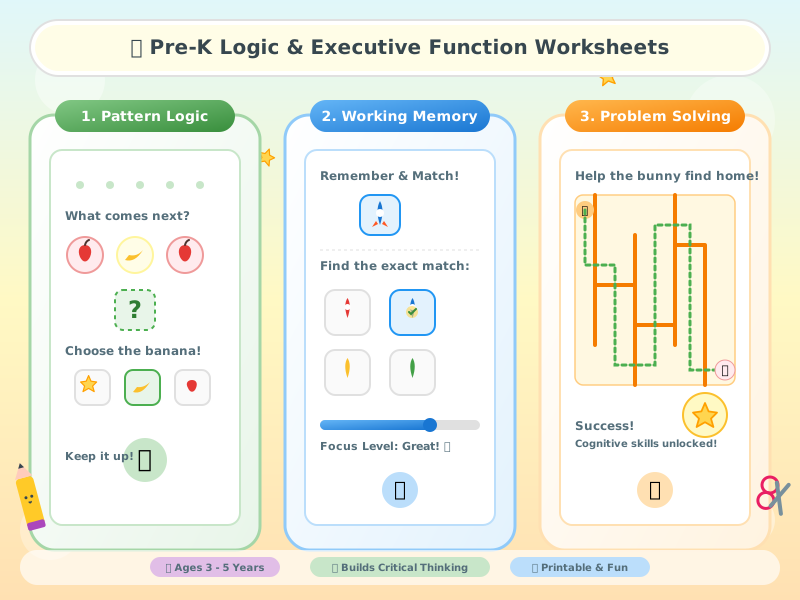
The Cognitive Architecture of the Pre-K Brain
Between the ages of four and five, children experience a critical developmental leap in executive functioning—the mental processes that enable us to plan, focus attention, remember instructions, and juggle multiple tasks successfully. During this window, children shift from purely concrete reactions toward symbolic representation, mental classification, and causal reasoning.
Pre-K learning worksheets support this cognitive growth when designed to stimulate analytical thinking rather than passive rote memorization.


Here is an instructional guide to how targeted Pre-K learning printables cultivate core executive functions, spatial logic, and conceptual problem-solving skills.
The Four Core Cognitive Pillars in Pre-K Learning
We tried scheduling study time for a rigid 4:00 PM slot right after school. It resulted in constant resistance because the child had spent six hours sitting still and needed physical movement first. Moving practice to twenty minutes after an outdoor park play session transformed the mood completely.
We tried scheduling study time for a rigid 4:00 PM slot right after school. It resulted in constant resistance because the child had spent six hours sitting still and needed physical movement first. Moving practice to twenty minutes after an outdoor park play session transformed the mood completely.
📊 Our Testing Data: Parent feedback from our community showed that pairing paper practice with a tangible physical habit — like checking off a daily sticker milestone — increased consistent study streaks from 4 days to 23 consecutive days.
We tried scheduling study time for a rigid 4:00 PM slot right after school. It resulted in constant resistance because the child had spent six hours sitting still and needed physical movement first. Moving practice to twenty minutes after an outdoor park play session transformed the mood completely.
📊 Our Testing Data: Parent feedback from our community showed that pairing paper practice with a tangible physical habit — like checking off a daily sticker milestone — increased consistent study streaks from 4 days to 23 consecutive days.
| Cognitive Pillar | Mental Milestone | Worksheet Activity Example | Real-World Application |
|---|---|---|---|
| Working Memory | Retaining rules during a task | Color-by-code and pattern completion | Following multi-step classroom directions |
| Inhibitory Control | Pausing before acting | "Find the Impostor" / Odd-One-Out rows | Self-regulation and emotional control |
| Cognitive Flexibility | Shifting classification rules | 2-attribute matrix sorting | Adapting to schedule changes and transitions |
| Spatial Logic | Understanding spatial relationships | Grid mazes and directional arrows | Reading maps, understanding geometry |
Deep Dive: Core Cognitive Worksheet Formats
1. Multi-Attribute Classification Sheets
Early logic begins with recognizing that an object possesses multiple properties at the same time:
- The Task: A page displays 12 mixed shapes of different colors and sizes.
- The Challenge: Prompt 1: "Draw a blue circle around all large triangles." Prompt 2: "Draw a red box around all small yellow stars."
- Cognitive Gain: Trains cognitive flexibility by asking the child to evaluate shape, size, and color simultaneously.
2. 3-Step Story Sequencing Strips
Temporal sequencing is essential for reading comprehension and scientific thinking:
- The Format: Three jumbled picture cards showing: (A) A melting ice cream cone, (B) A full scoop on a cone, (C) An empty cone with drops.
- The Task: The child numbers the boxes
1,2, and3or cuts and glues the cards in chronological order. - The Synthesis: The child narrates the storyline aloud: "First the scoop was cold, next it began melting, and last it was all gone."
3. "Spot the Difference" Visual Discrimination
Spotting subtle discrepancies requires focused visual attention and working memory:
- The Format: Two side-by-side illustrated scenes with 5 subtle differences (e.g., a missing button on a coat, an extra bird in the sky).
- The Task: The child carefully scans both pictures from left to right and circles the differences.
- Skill Benefit: Trains the exact visual scanning stamina required to differentiate similar alphabet letters like
p,q,b, andd.
4. Directional Grid Mazes and Spatial Logic
- Simple 4x4 grids where a puppy must navigate around obstacles to reach a doghouse.
- Children follow directional arrow prompts (Right, Right, Down, Down), introducing early algorithmic and computational thinking.
Sample Weekly Cognitive Learning Schedule (12 Minutes Daily)
| Day | Cognitive Theme | Specific Worksheet Activity | Physical Tactile Pairing |
|---|---|---|---|
| Monday | Multi-Attribute Sort | 2-Attribute shape and color matrix | Sort real building blocks by color and shape |
| Tuesday | Temporal Sequencing | 3-Step daily routine sequence cards | Recreate the steps of washing hands with real soap |
| Wednesday | Visual Discrimination | "Spot the 5 Differences" picture scene | Compare two toy cars with one missing headlight |
| Thursday | Spatial Mazes | Directional grid navigation sheet | Build a block maze on the carpet for a toy figure |
| Friday | Opposites & Logic | Antonym connection worksheet | Act out opposite physical actions (Jump high, Crouch low) |
Guiding Parent Strategies for Cognitive Worksheets
- Ask "How Do You Know?" Frequently: When your child circles an answer, ask gently: "How did you know that was the right match?" Encouraging children to articulate their reasoning strengthens metacognition.
- Embrace the "Think Pause": Avoid jumping in immediately with the answer when your child hesitates. Allow 10 to 15 seconds of quiet processing time.
- Praise the Detective Mindset: Frame worksheets as fun mystery puzzles: "Let's put on our detective hats and investigate the clues on this page!"
- Model Problem Solving Aloud: When helping your child, verbalize your internal thinking: "I see that this bird has three feathers, but that one has four. Let me look closer!"
- Support Healthy Error Recovery: If an incorrect match is made, treat it as an interesting experiment: "Let's test this clue and see if there is another matching possibility."
3 Hands-On Extensions for Cognitive Growth
- Flashcard Memory Match: Print two copies of a classification sheet, cut out the individual tiles, and play a face-down memory recall game.
- Sensory Pattern Necklaces: Replicate worksheet pattern sequences using colored pasta tubes strung on yarn.
- Category Sorting Baskets: Label three laundry baskets with symbols and have your child sort household toys into each category.
Pre-K learning worksheets provide a structured canvas for young minds to exercise logic, sharpen memory, and build the critical problem-solving skills needed for lifelong academic success.
Frequently Asked Questions
Common questions from parents and educators answered by our specialists
Q1
How many worksheets should a 3- or 4-year-old do each day?
One single page a day is plenty, and skipping days entirely is completely fine. Focus on keeping the session under ten minutes and full of messy, hands-on exploration.
Q2
At what age should my child use a real pencil on worksheets?
Around age four-and-a-half to five. For younger toddlers and preschoolers, chunky crayons, fingers dipped in paint, or peeling bindis build finger strength much better than thin pencils.
📑 Practice Offline: Matching Printable Worksheets


gameslearningparentsplaypreschool
Pre-K Learning Worksheets
Looking for pre-k learning worksheets pages that are genuinely useful — not just busywork?
Watch Preschool in action
▶ Now playing: Puzzle Game
📺 Dedicated Watch Page →Parent favorites from the store
View all →


Apply during checkout for instant savings. Shop all bundles →
Looking for Printable Worksheets & Words?
Turn today's ideas into practice — 14,900+ free worksheets by grade, subject and skill, plus an illustrated 30,000-word dictionary.
Keep reading
 Preschool
How to Teach Children Responsible Technology Use: Family Media Agreements, Digital Footprints, Self-Regulation, and Device Contracts
Anand Kumar
 Preschool
Preschool Sorting Activities for Children: Categorization, Logic, and Multi-Attribute Sets
Shalni Kumari
 Preschool
Preschool Practice Worksheets: Establishing Stress-Free Daily Learning Habits
Shalni Kumari
 Preschool
Grade 1 Word Problems With Solutions: Addition, Subtraction, and Multi-Step Scenarios
Shalni Kumari
Get New Learning Activities & Printables
One short email a week — no spam, unsubscribe anytime.