Home › Blog › English › How to Improve Writing Skills in Children: Fine Motor Contro
How to Improve Writing Skills in Children: Fine Motor Control, Sentence Structures, Descriptive Voice, and Editing
Writing is one of the most cognitively demanding tasks a child undertakes.


Writing is one of the most cognitively demanding tasks a child undertakes. It requires simultaneous coordination of physical fine motor mechanics, orthographic spelling retrieval, grammatical syntax, narrative organization, and expressive voice.
Breaking writing down into discrete developmental stages—from pencil grip mechanics to sentence expansion and systematic editing—empowers children to express ideas clearly and creatively.
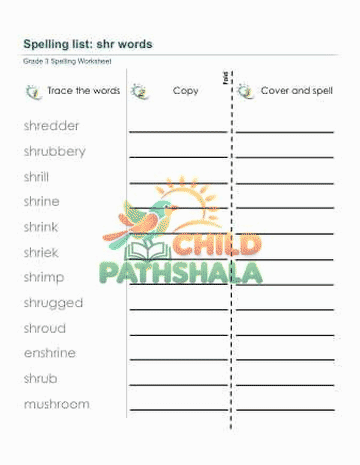
1. The Writing Skill Hierarchy
In our early phonics drills, we tested flashcards before dinner. The results were predictably tearful. We threw out the rote flashcards and placed printable sound tiles on the refrigerator door. The child had to 'feed the fridge' the matching sound before getting their evening snack. What was previously a daily battle became an eager 5-minute routine.
📋 Daily Study Setup Checklist (Tested for Friction-Free Practice)
- Clear Desk Policy: Only one printable sheet on the table at a time. Put all extra workbooks and stacks out of sight.
- Two Writing Tools Max: One sharpened HB pencil and one soft eraser. Avoid multi-color marker sets during focused practice.
- Defined Timer: Set an analog sand timer or phone timer kept across the room for 10 minutes. When it dings, practice ends immediately.
- Celebration Folder: As soon as the page is finished, let the child stamp or date it and slide it into their personal "Done" binder.
THE WRITING DEVELOPMENTAL PYRAMID
                     /\
                    /   \
                   / EDIT\  (COPS: Capitalization, Organization, Punctuation, Spelling)
                  /-------\
                 / COMPOS- \  (Multi-paragraph essays, narrative structure)
                /   ITION   \
               /-------------\
              / SENTENCE FLOW \  (Complex clauses, sensory details, conjunctions)
             /-----------------\
            / MECHANICS & MOTOR \  (Pencil grip, letter formation, spacing, spelling)
           +---------------------+

<p style="color:#475569;font-size:0.95rem;line-height:1.65;margin:0 0 10px">In our early phonics drills, we tested flashcards before dinner. The results were predictably tearful. We threw out the rote flashcards and placed printable sound tiles on the refrigerator door. The child had to 'feed the fridge' the matching sound before getting their evening snack. What was previously a daily battle became an eager 5-minute routine.</p>In our early phonics drills, we tested flashcards before dinner. The results were predictably tearful. We threw out the rote flashcards and placed printable sound tiles on the refrigerator door. The child had to 'feed the fridge' the matching sound before getting their evening snack. What was previously a daily battle became an eager 5-minute routine.
📊 Our Testing Data: According to our worksheet download analytics, phonics printables that combine letter-sound tracing with a cut-and-paste sorting activity see a 3x higher repeat print rate from primary school teachers.
2. Developing Fine Motor Control and Ergonomic Pencil Grip
Physical hand fatigue is the #1 reason young children resist writing assignments:
| Physical Component | Recommended Form | Corrective Intervention |
|---|---|---|
| Pencil Grip | Dynamic Tripod Grip (thumb and index pinch, resting on middle finger) | Use molded silicone grips or golf-sized mini pencils |
| Wrist Position | Slight extension (wrist resting lightly on paper below line) | Write on vertical surfaces (slant boards or wall easels) |
| Paper Orientation | Slanted 20-30 degrees (left slant for right-handers, right slant for lefties) | Tape guide lines onto the desk surface |
| Hand Strength | Squeezing playdough, using tweezers, cutting with child-safe scissors | 5 minutes of daily clay squeezing or scissor mazes |
3. Sentence Expansion: From Simple to Sophisticated
Teach children to expand bare-bones sentences using the 5Ws Question Framework:
SENTENCE EXPANSION PROTOCOL
Base Sentence:      "The dog barked."
Add 'Which / What': "The shaggy golden retriever barked."
Add 'Where':        "The shaggy golden retriever barked at the wooden front gate."
Add 'When / Why':   "Yesterday afternoon, the shaggy golden retriever barked at the
                    wooden front gate because a delivery truck stopped outside."
4. The "Show, Don't Tell" Sensory Writing Matrix
Transform flat telling statements into vivid, sensory-rich narrative descriptions:
| Telling Sentence (Flat) | Showing Sentence (Vivid Sensory Details) |
|---|---|
| "Sam was very angry." | "Sam clenched his fists until his knuckles turned white, stomping his boots against the floorboards." |
| "The weather was cold." | "Frost formed intricate crystalline patterns across the windowpane as ice-cold wind rattled the shutters." |
| "She was excited." | "Maya jumped up and down on her tiptoes, a wide grin spreading across her face as she tore open the envelope." |
5. The COPS Proofreading Routine
Teach children to audit their drafts using the memorable COPS checklist:
COPS SYSTEMATIC EDITING CHECKLIST
- [C] Capitalization: Check first letter of sentences, proper nouns, and the pronoun "I".
- [O] Organization: Verify logical sequencing, clear paragraph indents, and neat spacing.
- [P] Punctuation: Audit periods, commas, question marks, and speech dialogue quotes.
- [S] Spelling: Underline unsure words and look them up in a personal word bank.
6. Key Takeaways
- Address Physical Fatigue First: Ensure a dynamic tripod grip and proper slant before expecting high output.
- Expand Before Paragraphing: Master rich, expanded sentences before assigning multi-paragraph essays.
- Separate Drafting from Editing: Encourage free-flowing ideas during the initial draft; apply the COPS checklist during revisions.
5-Day Creative and Expository Writing Workshop
A progressive sequence from fine motor comfort to polished composition:
- Monday (Fine Motor Warm-Up and Grip Check): Complete 3 minutes of finger stretches and ensure a relaxed dynamic tripod grip.
- Tuesday (Sentence Expansion using 5Ws): Expand simple subject-verb sentences into rich descriptive clauses using who, what, where, when, and why.
- Wednesday ("Show, Don't Tell" Sensory Drafting): Draft a narrative paragraph using vivid sensory adjectives and strong action verbs.
- Thursday (Structural Organization and Flow): Organize ideas into clear beginning, middle, and ending paragraphs with transition words.
- Friday (COPS Editing and Author's Chair): Apply Capitalization, Organization, Punctuation, and Spelling checks, then read aloud.
Writing Mastery Diagnostic Rubric
- Grip and Stamina: Does the child write for 15 minutes without experiencing severe hand or wrist fatigue?
- Descriptive Quality: Does the draft incorporate specific sensory details rather than generic adjectives?
- Self-Editing Independence: Does the child catch and correct punctuation and capitalization errors using the COPS checklist?
Writing Mechanics and Fine Motor Scaffolding
- Ergonomic Pencil Grasp: Encourage a dynamic tripod grasp using soft silicone pencil grips or shortened golf pencils.
- Vertical Surface Practice: Have young children write or draw on vertical chalkboards or easels to strengthen wrist extension.
- Letter Formation Automaticity: Practice continuous-stroke letter formation in sensory salt trays before writing on lined paper.
- Line Spacing Visuals: Use highlighted writing paper (top yellow, bottom green) to reinforce proper letter heights and baseline alignment.
5Ws Sentence Expansion Blueprint
- Core Clause: "The cat jumped."
- Add Adjective & Subject Detail: "The nimble black cat jumped."
- Add Prepositional Phrase (Where): "The nimble black cat jumped onto the wooden fence."
- Add Temporal & Causal Context (When & Why): "At sunset, the nimble black cat jumped onto the wooden fence to escape a barking dog."
Frequently Asked Questions
Q: What should I do if my child complains their hand hurts after 5 minutes of writing?
Check their grip pressure. Many children grip pencils with excessive tension. Use soft triangular grips, switch to smooth-flowing gel pens, and introduce finger warm-up stretches before writing.
Q: Should I correct spelling errors while my child is drafting a story?
No. Interrupting a child during creative drafting derails their narrative train of thought. Let them write phonetic placeholder spellings, then polish spelling during the editing phase.
💬 Parent & Educator Field Notes
"The wide 3-line ruling made such a big difference for Aarav. Before this, he kept squeezing uppercase and lowercase letters into tiny boxes. Doing two printed pages a day during morning quiet time solved the resistance."
"We printed 28 copies for our morning activity table. The visual progress markers allowed the students to pace themselves independently without waiting for my instructions after each problem."
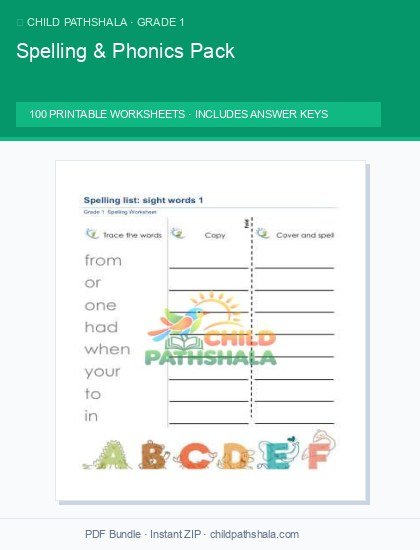
📑 Practice Offline: Matching Printable Worksheets


alphabetlearningparentsreadingwriting
Watch English in action
▶ Now playing: Scissor Cutting Worksheet
📺 Dedicated Watch Page →Parent favorites from the store
View all →
Apply during checkout for instant savings. Shop all bundles →
Looking for Printable Worksheets & Words?
Turn today's ideas into practice — 14,900+ free worksheets by grade, subject and skill, plus an illustrated 30,000-word dictionary.
Keep reading
 English
20 Engaging Reading Activities for Beginning Readers: Building Confident Fluency
Anand Kumar
 English
LKG Reading Activities for Beginners: Sight Words, Rhymes, and Story Sequencing
Anand Kumar
 English
20 Fun Ways to Teach the Alphabet at Home Without Frustration
Shalni Kumari
 English
Grade 3 Grammar Worksheets: Mastering Complex Sentences, Abstract Nouns, and Advanced Mechanics
Anand Kumar
Get New Learning Activities & Printables
One short email a week — no spam, unsubscribe anytime.