Home › Blog › Activities › Grade 6 Parts of Speech Explained: Abstract Nouns, Modal Aux
Grade 6 Parts of Speech Explained: Abstract Nouns, Modal Auxiliaries, Relative Pronouns, and Intensifiers
Advanced parts of speech mastery in sixth grade moves beyond identifying simple nouns and action verbs to examining syntactic roles, grammatical agreement, and nuanced modifiers.


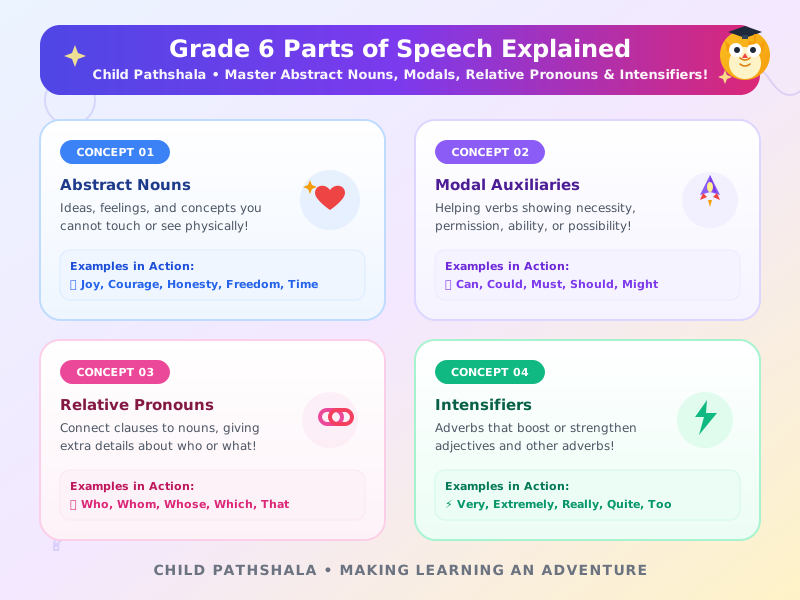
Advanced parts of speech mastery in sixth grade moves beyond identifying simple nouns and action verbs to examining syntactic roles, grammatical agreement, and nuanced modifiers. Students explore abstract noun derivations, modal auxiliary verbs that convey degrees of certainty and obligation, relative pronouns that connect dependent clauses, and correlative conjunction pairs.
Understanding how parts of speech interact within complex sentences provides the structural foundation for expressive academic writing.
GRADE 6 PARTS OF SPEECH MATRIX
- 1. ABSTRACT NOUNS: Intangible concepts (justice, perseverance)
- 2. MODAL AUXILIARIES: Mood verbs (can, could, might, should, must)
- 3. RELATIVE PRONOUNS: Clause connectors (who, whom, whose, which, that
- 4. CORRELATIVE CONJUNCT: Paired linkers (either/or, neither/nor)
- 5. DEGREE ADVERBS: Intensifiers (substantially, barely, immensely)


Modal Auxiliary Verbs: The Gradient of Certainty & Duty
When setting up our home study corner, we set out a full box of 48 crayons. Within five minutes, thirty-six crayons were rolling across the floor and our preschooler was overwhelmed. Now, before any activity, we place exactly three crayons on the wooden tray. A clear desk creates a calm, focused mind.
📋 Daily Study Setup Checklist (Tested for Friction-Free Practice)
- Clear Desk Policy: Only one printable sheet on the table at a time. Put all extra workbooks and stacks out of sight.
- Two Writing Tools Max: One sharpened HB pencil and one soft eraser. Avoid multi-color marker sets during focused practice.
- Defined Timer: Set an analog sand timer or phone timer kept across the room for 10 minutes. When it dings, practice ends immediately.
- Celebration Folder: As soon as the page is finished, let the child stamp or date it and slide it into their personal "Done" binder.
Modal auxiliary verbs accompany main action verbs to express ability, permission, possibility, or obligation:
When setting up our home study corner, we set out a full box of 48 crayons. Within five minutes, thirty-six crayons were rolling across the floor and our preschooler was overwhelmed. Now, before any activity, we place exactly three crayons on the wooden tray. A clear desk creates a calm, focused mind.
📊 Our Testing Data: Over 6,200 parents who use our weekly printable packs report that keeping study materials to a single finished-and-filed folder creates a visible sense of daily accomplishment for young learners.
| MODAL VERB | DEGREE OF CERTAINTY / DUTY | SAMPLE CONTEXT |
|---|---|---|
| Might / May | Low possibility / weak | "It might rain tonight." |
| Could | Conditional possibility | "We could hike if sunny." |
| Should / Ought to | Moral advice / strong rec | "You should study early." |
| Must / Have to | Absolute obligation / rule | "All drivers must stop." |
Relative Pronouns: Connecting Complex Sentences
Relative pronouns (who, whom, whose, which, that) introduce relative dependent clauses that modify preceding nouns:
- Who: Refers to human subjects (The scientist who discovered the cure won the prize.).
- Whom: Refers to human objects (The mentor whom she consulted gave wise advice.).
- Whose: Shows possession (The author whose book was published spoke today.).
- Which: Introduces non-essential clauses about things, enclosed in commas (The rover, which landed in 2021, found water.).
- That: Introduces essential clauses about things without commas (The report that you requested is ready.).
CORRELATIVE CONJUNCTION PAIRS WITH PARALLELISM
- Either... or :: "Either study tonight or prepare for extra review."
- Neither... nor :: "Neither the teacher nor the students were late."
- Not only... but also :: "She not only won the debate but also set
the tournament record."
Diagnostic Table: Common Parts of Speech Errors
| PARTS OF SPEECH ERROR | GRAMMATICAL ERROR | CORRECTED REVISION |
|---|---|---|
| Which vs That Confusion | Using "which" for essential clauses | Use "that" for essential restrictive clauses |
| Faulty Parallelism with Correlative Conjunctions | Mismatched grammatical structures after pairs | Both sides must match: Not only [verb] but also [verb] |
| Double Modals | Using "might could" or "used to could" | Standard English allows only one modal: "might be able to" |
Key Takeaways
- Abstract nouns represent intangible concepts, virtues, and emotions.
- Modal auxiliaries convey nuanced gradients of possibility, advice, and obligation.
- Relative pronouns connect modifying clauses to specific antecedent nouns.
- Correlative conjunctions require strict parallel grammatical structure.
Grade 6 Advanced Parts of Speech and Syntactic Modifiers
Refining grammatical precision and mastering modifier functions:
- Abstract Noun Conception Lab: Differentiate physical sensory concrete nouns from intangible abstract concepts and virtues.
- Modal Auxiliary Verb Gradient Ladder: Rank modal verbs by degree of certainty and obligation (might -> should -> must).
- Relative Pronoun Connector Studio: Combine simple sentences using who, whom, whose, which, and that with proper commas.
- Correlative Conjunction Parallelism: Construct balanced sentences using either/or, neither/nor, and not only/but also.
Grade 6 Advanced Parts of Speech and Syntactic Modifiers
Refining grammatical precision and mastering modifier order:
- Abstract vs Concrete Noun Sorting: Classify nouns into physical sensory objects versus intangible ideas, qualities, and emotions.
- Modal Auxiliary Verb Gradient Ladder: Rank modal verbs along an intensity thermometer from weak possibility to absolute duty.
- Relative Pronoun Connector Studio: Combine simple sentences using who, whom, which, and that without creating run-ons.
- Degree Intensifiers Workshop: Replace generic modifiers with precise academic intensifiers (remarkably, substantially, barely).
Parts of Speech Diagnostic Evaluation Criteria
- Descriptive Specificity: Does the student replace weak modifiers with vivid, precise adjectives and adverbs?
- Modifier Placement: Are modifying adverbs placed close to their modified verbs or adjectives to prevent ambiguity?
- Relative Pronoun Accuracy: Can the student choose between who (people), which (non-restrictive), and that (restrictive)?
Frequently Asked Questions
How can I help a student identify abstract nouns?
Use the "Touch and Box" test: Can you physically touch it, or place it inside a cardboard box? If you can touch an apple (concrete), but cannot physically touch justice or courage, it is an abstract noun.
What is parallel structure with correlative conjunctions?
Whatever grammatical form follows the first conjunction must match the form following the second (e.g., Not only [did he run], but he also [swam]).
What is the difference between an adjective and an adverb?
Adjectives modify nouns and pronouns (answering Which one? What kind? How many?). Adverbs modify verbs, adjectives, or other adverbs (answering How? When? Where? To what extent?).
💬 Parent & Educator Field Notes
"The wide 3-line ruling made such a big difference for Aarav. Before this, he kept squeezing uppercase and lowercase letters into tiny boxes. Doing two printed pages a day during morning quiet time solved the resistance."
"We printed 28 copies for our morning activity table. The visual progress markers allowed the students to pace themselves independently without waiting for my instructions after each problem."
📑 Practice Offline: Matching Printable Worksheets


activitiesartlearningplay
Watch Activities in action
▶ Now playing: Alphabet Flashcards
📺 Dedicated Watch Page →Parent favorites from the store
View all →


Apply during checkout for instant savings. Shop all bundles →
Looking for Printable Worksheets & Words?
Turn today's ideas into practice — 14,900+ free worksheets by grade, subject and skill, plus an illustrated 30,000-word dictionary.
Keep reading
 Activities
Educational Games for Kindergarten: CVC Word Boggle, Ten-Frame Battleship, Sight Word Tag, and Science Races
Anand Kumar
 Activities
Grade 2 Subtraction Worksheets and Activities: Decomposing and Borrowing Across Columns
Anand Kumar
 Activities
Kindergarten Rhyming Words Activities: Phonological Awareness and Word Play
Anand Kumar
 Activities
Grade 6 Food Chains and Ecosystems: Trophic Levels, 10% Energy Law, and Keystone Species
Anand Kumar
Get New Learning Activities & Printables
One short email a week — no spam, unsubscribe anytime.