Home › Blog › Science › Grade 5 Social Studies Syllabus and Topics: Age of Explorati
Grade 5 Social Studies Syllabus and Topics: Age of Exploration, Colonial Settlements, Revolutions, and Civics
Social Studies in fifth grade immerses students in historical chronology, geographic systems, economic principles, and constitutional democracy.


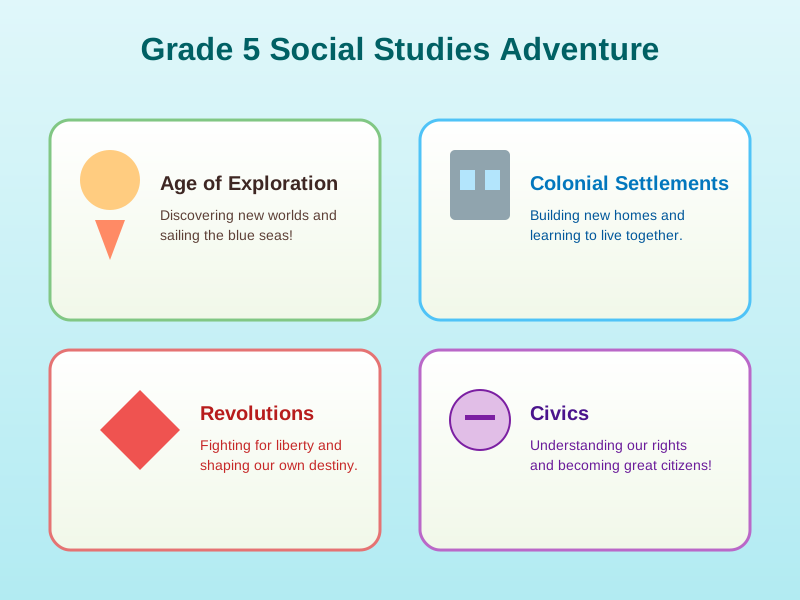
Social Studies in fifth grade immerses students in historical chronology, geographic systems, economic principles, and constitutional democracy. In Grade 5, curricula span the transformative eras of early world exploration, indigenous cultures, colonial settlements, conflicts, the drafting of the Constitution, and westward territorial expansion.
Analyzing primary source documents, interpreting historical maps, and debating perspectives transforms history into an active, analytical dialogue.
GRADE 5 SOCIAL STUDIES CURRICULUM TIMELINE
- 1. INDIGENOUS SOCIETIES: Eastern Woodlands, Plains, Southwest cultures
- 2. AGE OF EXPLORATION: Columbian Exchange, maritime routes, trade
- 3. 13 COLONIAL REGIONS: New England, Middle, & Southern Colonies
- 4. ERA: Causes, Declaration of Independence, War
- 5. CONSTITUTION & LAW: Preamble, Bill of Rights, 3 Government Branches


The 13 British Colonies: 3 Distinct Regional Economies
| COLONIAL REGION | GEOGRAPHY & CLIMATE | PRIMARY ECONOMIC BASE |
|---|---|---|
| New England | Rocky soil, cold winters, | Shipbuilding, fishing, |
| (MA, NH, CT, RI) | dense timber forests | whaling, ocean trade |
| Middle Colonies | Fertile soil, moderate | Wheat, rye, livestock |
| (NY, PA, NJ, DE) | climate ("Breadbasket") | flour mills, ironwork |
| Southern Colonies | Rich fertile soil, long warm | Cash crop plantations |
| (MD, VA, NC, SC, GA | growing season | (tobacco, rice, indigo |
When setting up our home study corner, we set out a full box of 48 crayons. Within five minutes, thirty-six crayons were rolling across the floor and our preschooler was overwhelmed. Now, before any activity, we place exactly three crayons on the wooden tray. A clear desk creates a calm, focused mind.
The Columbian Exchange: Global Impact
The transatlantic voyage of Columbus initiated a massive global transfer of biological organisms between the Eastern and Western Hemispheres:
- From Americas to Europe/Asia: Potatoes, corn/maize, tomatoes, cacao (chocolate), tobacco, pumpkins.
- From Europe/Asia to Americas: Horses, cattle, wheat, sugar cane, coffee, smallpox disease.
ROAD TO THE AMERICAN REVOLUTION
- 1. FRENCH & INDIAN WAR (1763): British debt leads to colonial taxation
- 2. STAMP ACT & TEA ACT: "No Taxation Without Representation!"
- 3. BOSTON TEA PARTY (1773): Sons of Liberty protest tea monopoly
- 4. BATTLES OF LEXINGTON (1775): "Shot Heard 'Round the World"
- 5. DECLARATION OF INDEP (1776): Thomas Jefferson drafts natural rights
The Constitutional Convention and Democratic Foundations
In 1787, delegates met in Philadelphia to draft the United States Constitution, establishing a democratic republic anchored by:
- The Preamble: Stating core purposes ("We the People, in Order to form a more perfect Union, establish Justice...").
- The Great Compromise: Establishing a bicameral legislature (Senate with equal state votes; House based on population).
- The Bill of Rights: Adding 10 individual liberty amendments to protect citizen rights against governmental overreach.
Diagnostic Error Analysis in Grade 5 Social Studies
ERROR 1: Viewing Historical Events as Inevitable
Remedy: Study historical events from multiple perspectives (Patriot vs
Loyalist vs Native American vs Enslaved individuals).
ERROR 2: Confusing the Declaration of Independence with the Constitution
Declaration (1776): Declared separation and listed grievances to King.
Constitution (1787): Established the formal legal structure of government
ERROR 3: Overlooking Geographic Influence on Regional Economies
Rule: Geography determines industry! Rocky New England could not farm
Southern cash crops, leading naturally to maritime trade.
Weekly Social Studies Workshop Progression
- Day 1 (Columbian Exchange Matrix): Categorize foods, animals, and diseases exchanged between hemispheres.
- Day 2 (13 Colonies Regional Map): Color-code the New England, Middle, and Southern colonial regions on maps.
- Day 3 ( Perspective Debate): Role-play Town Hall debates between colonial Patriots and British Loyalists.
- Day 4 (Primary Source Analysis): Analyze excerpts from the Declaration of Independence and annotate key grievances.
- Day 5 (Constitutional Preamble Studio): Dissect the Preamble and translate each constitutional goal into modern student words.
Grade 5 Social Studies Historical Inquiry and Civics
Investigating global exploration, colonial settlements, and constitutional foundations:
- The Columbian Exchange Global Mapping: Map the worldwide biological exchange of crops, livestock, and diseases between Eastern and Western Hemispheres.
- 13 Colonial Regional Economic Comparison: Contrast New England maritime trade, Middle Colony grain agriculture, and Southern plantation cash crops.
- Declaration of Independence Primary Source Clinic: Dissect 1776 primary source grievances and translate 18th-century language into modern meaning.
- Three Branches of Government Checks and Balances: Solve constitutional scenarios where legislative, executive, and judicial branches check each other.
Grade 5 Social Studies Document-Based Inquiry Stations
Structured primary-source investigations exploring American history and global exploration:
- Station 1 (Navigational Tools of Exploration): Investigate astrolabes, magnetic compasses, and caravel ship designs.
- Station 2 (Colonial Economic Specialization): Compare regional economies of the New England, Middle, and Southern colonies.
- Station 3 (Road to Revolution Perspectives): Analyze political broadsides from Patriot and Loyalist viewpoints.
- Station 4 (The Constitutional Convention): Debate the Great Compromise and separation of powers between government branches.
Historical Thinking Assessment Rubric
- Source Credibility Evaluation: Can the student identify author bias, historical context, and intended audience in primary documents?
- Causality Chains: Does the student trace multi-step cause-and-effect relationships leading up to historical conflicts?
- Civic Principle Application: Can the student explain how the U.S. Constitution balances national power with state autonomy?
Frequently Asked Questions
Q: Why is the Columbian Exchange considered a turning point in world history?
It permanently reshaped global diets, agriculture, and human populations by introducing New World crops worldwide while devastating indigenous populations through introduced diseases.
Q: What does "No Taxation Without Representation" mean?
Colonists argued that because they had no elected representatives in the British Parliament, Parliament had no legal right to impose taxes on them.
Q: What was the purpose of the Bill of Rights?
To guarantee that the newly created federal government could never infringe upon fundamental individual liberties, such as free speech and fair trials.
Key Takeaways
- Regional colonial economies were directly shaped by local climate and geography.
- The Columbian Exchange transformed global agriculture and demographics.
- The American Revolution arose from disputes over democratic self-governance and taxation.
- The US Constitution establishes a balanced republic protected by the Bill of Rights.
📑 Practice Offline: Matching Printable Worksheets


activitieslearningscience
Watch Science in action
▶ Now playing: Child Pathshala Printables
📺 Dedicated Watch Page →Parent favorites from the store
View all →
Apply during checkout for instant savings. Shop all bundles →
Looking for Printable Worksheets & Words?
Turn today's ideas into practice — 14,900+ free worksheets by grade, subject and skill, plus an illustrated 30,000-word dictionary.
Keep reading
 Science
Kindergarten Letter Sounds Activities: Auditory Discrimination and Phonics Drills
Anand Kumar
 Science
Grade 6 Social Science Syllabus and Topics: Ancient Civilizations, Geography, World Religions, and Early Governance
Anand Kumar
 Science
Grade 6 Force and Motion: Vector Forces, Acceleration Formulas, Kinetic Friction, and Momentum
Anand Kumar
 Science
Animals Worksheets: Classifying Mammals, Birds, Reptiles, Amphibians, Fish, and Insects
Anand Kumar
Get New Learning Activities & Printables
One short email a week — no spam, unsubscribe anytime.