Home › Blog › English › Grade 2 Story Writing Topics: Beginning, Middle, and Ending
Grade 2 Story Writing Topics: Beginning, Middle, and Ending Narrative Frameworks
Story writing in Grade 2 harnesses a child's vibrant natural imagination and channels it into structured narrative composition.


Awakening the Creative Storyteller in Grade 2
Story writing in Grade 2 harnesses a child's lively natural imagination and channels it into structured narrative composition. Seven- and eight-year-old students love inventing tales about brave astronauts, mischievous talking animals, magical hidden doors, and everyday playground adventures.
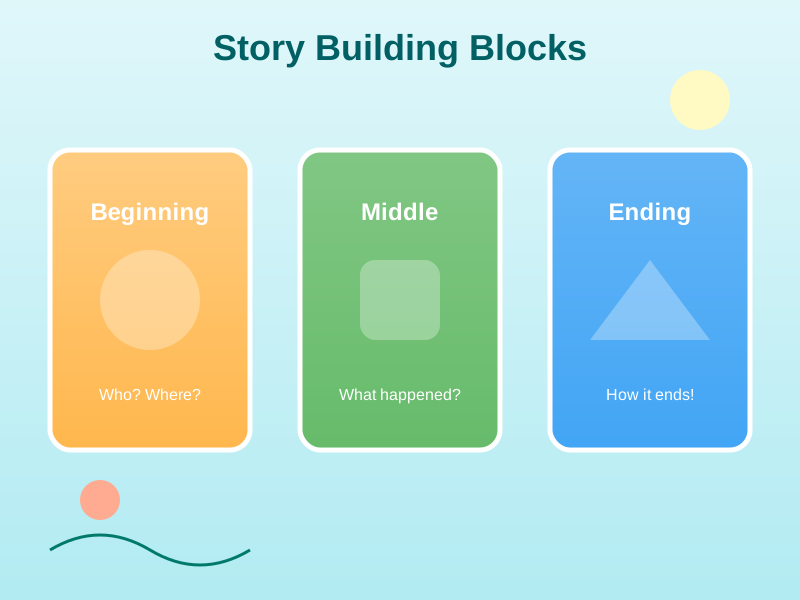
An effective story writing pedagogy equips young authors with a reliable narrative framework: understanding that every compelling story introduces interesting Characters and a vivid Setting (Beginning), faces an exciting Problem or Challenge (Middle), and reaches a satisfying Solution (Ending).
THE 3-ACT NARRATIVE STORY MOUNTAIN
- 1. THE BEGINNING (Base) -> Introduce Main Character, Setting, Goal
- 2. THE MIDDLE (Climb) -> The Problem arises! Actions taken to solve it
- 3. THE ENDING (Peak/End)-> Problem is solved; character feeling/lesson
When testing early handwriting tracing sheets, we purchased fancy ergonomic triangular pencil grips from a local stationery shop. The children spent more time pulling the rubber grips off and rolling them across the desk than practicing letters. What actually worked? Giving the child a rolled-up marble of tissue paper to hold against their palm with their pinky and ring fingers while writing. It naturally forced the index finger and thumb into a clean tripod grasp.
When testing early handwriting tracing sheets, we purchased fancy ergonomic triangular pencil grips from a local stationery shop. The children spent more time pulling the rubber grips off and rolling them across the desk than practicing letters. What actually worked? Giving the child a rolled-up marble of tissue paper to hold against their palm with their pinky and ring fingers while writing. It naturally forced the index finger and thumb into a clean tripod grasp.
📊 Our Testing Data: Classroom observation across 40 early learners showed that hand fatigue set in after just four lines of repetitive letter tracing. Alternating one line of tracing with one line of matching or picture circling doubles handwriting endurance.
When testing early handwriting tracing sheets, we purchased fancy ergonomic triangular pencil grips from a local stationery shop. The children spent more time pulling the rubber grips off and rolling them across the desk than practicing letters. What actually worked? Giving the child a rolled-up marble of tissue paper to hold against their palm with their pinky and ring fingers while writing. It naturally forced the index finger and thumb into a clean tripod grasp.
📊 Our Testing Data: Classroom observation across 40 early learners showed that hand fatigue set in after just four lines of repetitive letter tracing. Alternating one line of tracing with one line of matching or picture circling doubles handwriting endurance.
15 Creative Grade 2 Story Writing Prompts Across 3 Themes
- THEME 1: MAGICAL & FANTASY ADVENTURES
- 1. The Day My Stuffed Teddy Bear Began Talking to Me
- 2. I Found a Golden Key That Unlocked a Secret Garden Door
- 3. The Friendly Cloud That Flew Down to Play on the School Swings
- 4. The Magic Paintbrush That Made Every Drawing Come to Life
- 5. An Enchanted Treehouse That Traveled Back to the Dinosaur Era
- THEME 2: ANIMAL COMPANION TALES
- 6. Barnaby the Beagle Who Wanted to Fly Like a Bird
- 7. The Little Squirrel Who Lost His Secret Winter Acorn Stash
- 8. A Lost Penguin Who Accidentally Landed in a Sunny Beach Town
- 9. The Brave Mouse Who Saved the Circus Lion from a Trap
- 10. The Detective Owl Who Solved the Mystery of the Missing Moon
- THEME 3: REAL-LIFE HEROES & EVERYDAY MYSTERIES
- 11. The Lost Kitten in the Storm Drain: How We Rescued Her
- 12. The Day the Entire School Playground Lost Power and Lights
- 13. A Mysterious Footprint Discovered in Our Backyard Snow
- 14. The Great Camping Disaster: When Raccoons Raided Our Cooler
- 15. The New Boy in School Who Had a Secret Superhero Talent
The 4-Box Storyboard Graphic Organizer
| STORYBOARD BOX | ESSENTIAL NARRATIVE ELEMENTS |
|---|---|
| Box 1: Character & Setting | - Who is the main character? (Max the dog |
| (Beginning) | - Where does the story start? (Sunny farm |
| Box 2: The Problem | - What goes wrong? (The farm gate opened |
| (Middle - Conflict) | and three baby piglets escaped!) |
| Box 3: The Action | - What does the character do? (Max barks |
| (Middle - Effort) | gently and herds piglets toward barn) |
| Box 4: The Solution & Feeling | - How is it resolved? (Piglets safe in pen |
| (Ending - Resolution) | - Max gets a crunchy bone and wags tail) |
4 High-Impact Story Writing Classroom Activities
| Activity Name | Materials Required | Target Story Writing Skill |
|---|---|---|
| Roll-a-Story Dice | 3 custom dice (who/where/what) | Spontaneous story starter |
| Character Passport | Foldable index cards | Developing personality |
| Mystery Story Box | 3 random household items | Weaving props into plot |
| Comic Strip Draft | 4-frame blank comic sheets | Visual narrative planning |
1. The Roll-a-Story 3-Dice Game
- Create three large foam dice:
- Die 1 (Character): Astronaut, Pirate, Wizard, Talking Dog, Baker, Knight
- Die 2 (Setting): Desert island, Haunted castle, Space rocket, Deep jungle
- Die 3 (Obstacle): Lost a key, Broken compass, Storm coming, Giant puddle
- Children roll all three dice and compose a story weaving the three rolled elements together.
2. Character Passport Identity Card
- Before writing, students design an identity card for their protagonist:
- Name, age, appearance traits (shaggy ears, red boots), favorite food, and secret superpower.
- Grounding the character visually prevents abstract, inconsistent storytelling.
5-Day Creative Story Writing Workshop Progression
| Day | Workshop Stage | Interactive Student Routine |
|---|---|---|
| Monday | Character & Setting | Designing character passport & environment |
| Tuesday | The Big Problem | Brainstorming the central conflict/mystery |
| Wednesday | Drafting the Climb | Writing the beginning and middle actions |
| Thursday | Resolving the Climax | Writing the satisfying conclusion & lesson |
| Friday | Author Chair Reading | Presenting illustrated book to the class |
Key Takeaways
- Story writing succeeds when structured with the Story Mountain (Beginning, Middle, Ending).
- Visual graphic organizers (4-box storyboards) help children plan conflicts before writing.
- Character design identity cards create relatable, consistent story protagonists.
- Celebrating finished drafts in the Author's Chair instills pride and a love for writing.
Creative Narrative Scaffolding and Story Design
Structuring imaginative story writing in Grade 2:
- The 3-Act Narrative Mountain Graphic Organizer: Have students map their characters, setting, problem, and solution on a visual mountain chart before beginning their draft.
- Character Design Identity Cards: Before writing, students draw their main character and record three key traits (appearance, personality, secret skill) to maintain consistency.
- The "Three-Action" Problem Resolution Rule: Limit stories to three attempts by the protagonist to solve the problem before reaching the climax, preventing endless wandering plots.
- Illustrated Mini-Book Publishing: Fold two sheets of paper into an 8-page mini-booklet where students write their story and illustrate key scenes with colored pencils.
Frequently Asked Questions
Q: What should I do if a child's story goes on endlessly without an ending?
Teach the "3-Action Rule": Once the problem occurs, the character can try only three actions to fix it before the resolution must happen. This keeps the narrative focused.
Q: How can I help a student who writes only two short sentences and stops?
Ask probing sensory questions: "What did the setting smell like? What did the character say out loud when they saw the monster? How did their heart feel?" Write down their spoken answers to expand the draft.
Q: Should Grade 2 students illustrate their stories?
Yes! Drawing illustrations before and after writing activates visual mental modeling, helping young authors imagine details they can describe in words.
📑 Practice Offline: Matching Printable Worksheets


alphabetphonicsreadingstorytellingwriting
Watch English in action
▶ Now playing: Reading
📺 Dedicated Watch Page →Parent favorites from the store
View all →
Apply during checkout for instant savings. Shop all bundles →
Looking for Printable Worksheets & Words?
Turn today's ideas into practice — 14,900+ free worksheets by grade, subject and skill, plus an illustrated 30,000-word dictionary.
Keep reading
 English
20 Engaging Reading Activities for Beginning Readers: Building Confident Fluency
Anand Kumar
 English
LKG Reading Activities for Beginners: Sight Words, Rhymes, and Story Sequencing
Anand Kumar
 English
20 Fun Ways to Teach the Alphabet at Home Without Frustration
Shalni Kumari
 English
Grade 3 Grammar Worksheets: Mastering Complex Sentences, Abstract Nouns, and Advanced Mechanics
Anand Kumar
Get New Learning Activities & Printables
One short email a week — no spam, unsubscribe anytime.