Home › Blog › Science › Grade 2 EVS Syllabus and Topics: Human Body, Living World, N
Grade 2 EVS Syllabus and Topics: Human Body, Living World, Natural Resources, and Society
Environmental Studies (EVS) in Grade 2 deepens a child's understanding of the interconnected physical, biological, and social world.


Fostering Scientific Inquiry and Environmental Understanding in Grade 2
Environmental Studies (EVS) in Grade 2 deepens a child's understanding of the interconnected physical, biological, and social world. Building upon the foundational sensory observations of Grade 1, the Grade 2 curriculum introduces functional systems: exploring internal human organs, plant growth requirements, animal survival adaptations, Earth's natural cycles, and community interdependence.
An effective Grade 2 EVS curriculum cultivates scientific questioning, observational recording, and environmental stewardship through hands-on investigations, outdoor nature labs, and social awareness projects.


THE 4 CORE THEMATIC PILLARS OF GRADE 2 EVS
- 1. HUMAN BODY & HEALTH -> Internal vs external organs, hygiene, balanced diet
- 2. THE LIVING WORLD -> Plant diversity (shrubs, herbs), animal diets
- 3. EARTH & RESOURCES -> Water cycle, air properties, sun/moon/seasons
- 4. SOCIETY & COMMUNITY -> Civic institutions, community helpers, safety
When setting up our home study corner, we set out a full box of 48 crayons. Within five minutes, thirty-six crayons were rolling across the floor and our preschooler was overwhelmed. Now, before any activity, we place exactly three crayons on the wooden tray. A clear desk creates a calm, focused mind.
Detailed Topic-Wise Grade 2 EVS Curriculum Breakdown
1. Human Body Systems, Senses, and Personal Health
| Curriculum Unit | Core Topics & Observable Concepts |
|---|---|
| Internal Organs Sense Organs Review Balanced Nutrition Personal Hygiene Safety & First Aid | Heart (pumps blood), Lungs (breathe air), Brain (think Stomach (digests food), Bones & Muscles (support body) Protecting eyes, ears, nose, tongue, skin from damage 3 food groups: Energy, Body-Building, Protective foods Oral care, proper handwashing, posture, daily exercise Basic home safety, road crossing rules, minor cuts |
2. The Living World: Botany and Zoology
| Curriculum Unit | Core Topics & Observable Concepts |
|---|---|
| Plant Classifications Plant Needs & Uses Animal Classifications Animal Habitats Animal Young & Sounds | Trees (thick trunk), Shrubs (woody), Herbs (soft stem) Climbers (need support), Creepers (grow along ground) Sunlight, water, soil; food, medicine, oxygen, fiber Herbivores (plant-eaters), Carnivores (meat-eaters), Omnivores (eat both); Domestic vs Wild animals Terrestrial, Aquatic, Arboreal; nests, burrows, dens Parents and babies (cow/calf, dog/puppy, frog/tadpole) |
3. Natural Resources, Earth, Weather, and Seasons
| Curriculum Unit | Core Topics & Observable Concepts |
|---|---|
| Air Properties | Air occupies space, has weight, is needed for burning |
| Water & Water Cycle | Sources (rain, rivers, lakes), filtration, saving water |
| Sun, Moon, and Stars | Day/Night Earth rotation, phases of the Moon |
| Four Seasons | Summer, Monsoon/Autumn, Winter, Spring adaptations |
| Earth Care & 3Rs | Reduce, Reuse, Recycle; proper waste segregation |
4. Our Society, Community Helpers, and Transport
| Curriculum Unit | Core Topics & Observable Concepts |
|---|---|
| Family Diversity | Nuclear, Joint, and Extended family structures |
| Neighborhood Services | Police stations, hospitals, fire houses, banks, parks |
| Transport Systems | Land (trains, cars), Water (ships), Air (airplanes) |
| Communication Tools | Letters, telephones, emails, newspapers, internet |
| National Identity | National flag, emblem, anthem, historic national days |
5-Day Weekly EVS Investigation Schedule
| Day | Theme | Practical Classroom / Home Science Lab |
|---|---|---|
| Monday | Human Body Anatomy | Stethoscope paper cone heartbeat listening |
| Tuesday | Plant Kingdom | Leaf rubbing vein audit & stem dissection |
| Wednesday | Animal Adaptations | Shoebox habitat diorama construction |
| Thursday | Earth & Water Cycle | Sealed ziplock bag water cycle on window |
| Friday | Civic Helpers | Community helper thank-you card workshop |
Key Takeaways
- Grade 2 EVS bridges everyday observation with foundational biological and physical sciences.
- Human biology shifts from outer body parts to essential internal organs (heart, brain, lungs).
- Botanical classification introduces precise terms: trees, shrubs, herbs, climbers, and creepers.
- Social studies emphasizes neighborhood citizenship and environmental conservation.
Grade 2 Environmental Studies Experiential Labs
Bridging scientific inquiry with daily life:
- The 3D Human Organ Shirt Craft: Have students paste colored paper cutouts of the brain, heart, lungs, stomach, and skeleton onto an oversized white t-shirt to visualize anatomical positions.
- Botanical Stem Capillary Action Experiment: Place white carnation flowers or celery stalks into jars of blue and red colored water to demonstrate how xylem vessels transport nutrients to leaves.
- Animal Classification Card Sorts: Provide decks of 20 animal cards for students to classify into Herbivore, Carnivore, and Omnivore categories based on teeth anatomy and diet.
- Neighborhood Map Floor Grid: Create a giant floor map with masking tape where students navigate toy emergency vehicles between hospitals, fire stations, and school zones.
Experiential Science Labs and Observation Journals for Grade 2 EVS
Bringing environmental science principles to life through tactile investigation:
- The Model Lung Demonstration: Construct a simple working lung model using an empty plastic bottle, a straw, and two latex balloons. Pulling the bottom balloon diaphragm demonstrates how air pressure inflates the internal lung balloon.
- Seed Dissection and Germination Anatomy: Soak large lima bean seeds in warm water overnight. Have students gently peel away the seed coat to observe the stored food cotyledon and miniature baby plant embryo inside using magnifying glasses.
- Comparative Animal Habitat Dioramas: Students work in collaborative teams to construct shoebox dioramas representing aquatic coral reefs, arid deserts, and tropical rainforests, labeling the unique physical adaptations of resident animals.
- The Sealed Window Water Cycle Lab: Fill a transparent ziplock bag with 50 mL of blue water, tape it securely to a sunny window, and observe daily evaporation, condensation cloud formation, and precipitation rainfall cycles.
Frequently Asked Questions
Q: How can teachers make internal organ anatomy easy for second graders?
Use simple physical analogies: Compare the heart to a garden water pump, the lungs to inflating balloons, the brain to the master control computer, and the stomach to a blender that churns food into fuel.
Q: What is the best way to demonstrate the water cycle in Grade 2?
Tape a sealed ziplock bag containing blue-tinted water to a sunny window. Students observe evaporation as the sun heats the water, condensation forming droplet clouds at the top, and precipitation raining down the inside walls.
Q: Why is plant classification important in Grade 2?
Classifying plants into herbs, shrubs, trees, climbers, and creepers trains children in scientific observation, taxonomy, and understanding diverse botanical adaptations.
📑 Practice Offline: Matching Printable Worksheets


activitieslearningparentsreadingscience
Watch Science in action
▶ Now playing: Child Pathshala Printables
📺 Dedicated Watch Page →Parent favorites from the store
View all →
Apply during checkout for instant savings. Shop all bundles →
Looking for Printable Worksheets & Words?
Turn today's ideas into practice — 14,900+ free worksheets by grade, subject and skill, plus an illustrated 30,000-word dictionary.
Keep reading
 Science
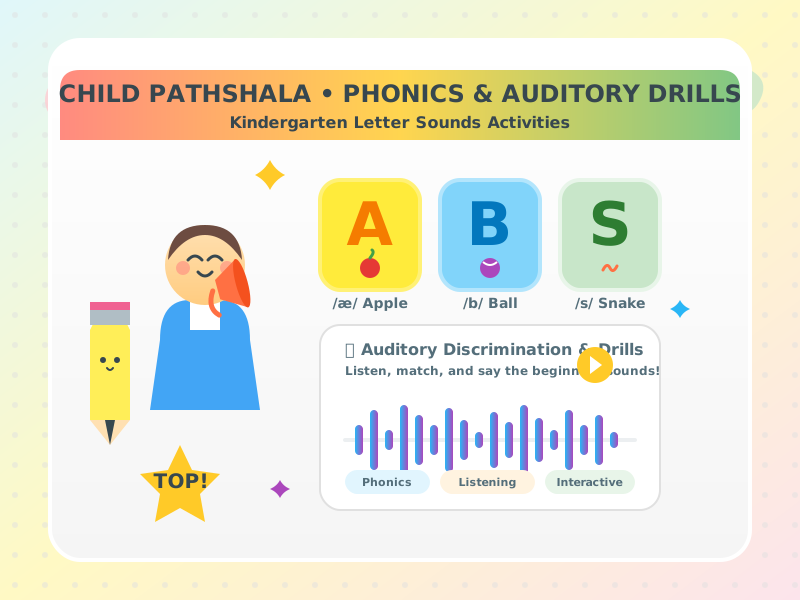
Kindergarten Letter Sounds Activities: Auditory Discrimination and Phonics Drills
Anand Kumar
 Science
Grade 6 Social Science Syllabus and Topics: Ancient Civilizations, Geography, World Religions, and Early Governance
Anand Kumar
 Science
Grade 6 Force and Motion: Vector Forces, Acceleration Formulas, Kinetic Friction, and Momentum
Anand Kumar
 Science
Animals Worksheets: Classifying Mammals, Birds, Reptiles, Amphibians, Fish, and Insects
Anand Kumar
Get New Learning Activities & Printables
One short email a week — no spam, unsubscribe anytime.