Home › Blog › Preschool › Grade 1 Assessment Questions by Subject: English, Mathematic
Grade 1 Assessment Questions by Subject: English, Mathematics, and EVS Evaluation Bank
Assessing first graders requires a sensitive, constructive approach that measures foundational understanding without causing test anxiety.


Diagnostic and Formative Assessment Strategies for Grade 1
Assessing first graders requires a sensitive, constructive approach that measures foundational understanding without causing test anxiety. In early primary education, assessments serve primarily as diagnostic compasses—revealing where a child demonstrates robust conceptual mastery and where targeted instructional scaffolding is required.
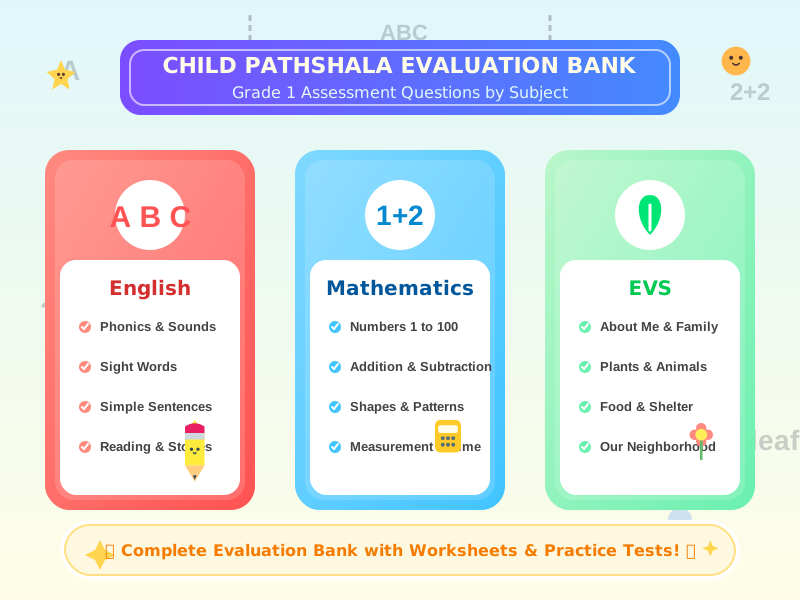
Effective Grade 1 assessments blend oral questions, pictorial matching, concrete manipulative demonstrations, and short written responses. Below is an age-appropriate assessment question bank spanning English Language Arts, Mathematics, and Environmental Studies (EVS).
CORE ASSESSMENT FORMATS FOR FIRST GRADERS
- 1. ORAL / INTERVIEW -> Phonemic blending, story retelling, counting out
- 2. PICTORIAL MATCH -> Circling correct shapes, connecting rhyming pairs
- 3. SHORT WRITTEN -> Missing numbers, one-sentence caption completion
- 4. HANDS-ON DEMO -> Building 10-frames, setting clock hands to 3:30
We tried scheduling study time for a rigid 4:00 PM slot right after school. It resulted in constant resistance because the child had spent six hours sitting still and needed physical movement first. Moving practice to twenty minutes after an outdoor park play session transformed the mood completely.
📋 Daily Study Setup Checklist (Tested for Friction-Free Practice)
- Clear Desk Policy: Only one printable sheet on the table at a time. Put all extra workbooks and stacks out of sight.
- Two Writing Tools Max: One sharpened HB pencil and one soft eraser. Avoid multi-color marker sets during focused practice.
- Defined Timer: Set an analog sand timer or phone timer kept across the room for 10 minutes. When it dings, practice ends immediately.
- Celebration Folder: As soon as the page is finished, let the child stamp or date it and slide it into their personal "Done" binder.
We tried scheduling study time for a rigid 4:00 PM slot right after school. It resulted in constant resistance because the child had spent six hours sitting still and needed physical movement first. Moving practice to twenty minutes after an outdoor park play session transformed the mood completely.
📊 Our Testing Data: Parent feedback from our community showed that pairing paper practice with a tangible physical habit — like checking off a daily sticker milestone — increased consistent study streaks from 4 days to 23 consecutive days.
1. English Language Arts Assessment Bank (30 Marks)
We tried scheduling study time for a rigid 4:00 PM slot right after school. It resulted in constant resistance because the child had spent six hours sitting still and needed physical movement first. Moving practice to twenty minutes after an outdoor park play session transformed the mood completely.
📊 Our Testing Data: Parent feedback from our community showed that pairing paper practice with a tangible physical habit — like checking off a daily sticker milestone — increased consistent study streaks from 4 days to 23 consecutive days.
Section A: Phonics and Word Recognition (10 Marks)
- Rhyme Identification: Which word rhymes with SUN? (a) Cat | (b) Run | (c) Big -> [Answer: (b) Run]
- CVC Word Reading: Read these five words aloud: MAP, BED, PIN, FOX, TUB.
- Silent-e Transformation: Change HOP into a new word with silent -e -> [Answer: HOPE]
- Sight Word Recognition: Circle the correct spelling: (a) sed | (b) said | (c) siad -> [Answer: (b) said]
Section B: Grammar & Parts of Speech (10 Marks)
- Noun Hunt: Circle the two nouns: The playful puppy ran to the park.
- Verb Hunt: Underline the action verb: Sam kicks the yellow ball.
- Pronoun Replacement: Replace the underlined name: Sara is reading. -> (He / She / They) -> [Answer: She]
- Plural Form: Write the plural of BOX -> [Answer: BOXES]
Section C: Sentence Construction (10 Marks)
- Unscramble the Sentence: likes / milk / the / cat -> [Answer: The cat likes milk.]
- Punctuation Correction: Rewrite with capital letter and period: we play outside on sunny days -> [Answer: We play outside on sunny days.]
2. Mathematics Assessment Bank (30 Marks)
GRADE 1 MATHEMATICS ASSESSMENT ITEMS
Item 1: Complete the number sequence: 47, 48, , 50, . [Ans: 49, 51]
Item 2: Decompose 36 into place value: Tens and Ones. [Ans: 3, 6]
Item 3: Calculate: 8 + 7 = __ [Ans: 15] | 14 - 6 = __ [Ans: 8]
Item 4: Fill the comparison: 64 is [greater than / less than] 46.
Item 5: Draw hands on clock face showing half-past 4 (4:30).
Item 6: Word Problem: Leo had 12 crayons. He gave 4 to Maya.
How many crayons does Leo have left? Equation: 12 - 4 = 8 crayons
3. Environmental Studies (EVS) Assessment Bank (30 Marks)
Section A: Human Body & Health (10 Marks)
- Which sense organ helps you smell fresh flowers? -> [Answer: Nose]
- Name two healthy foods that give us energy to play. -> [Answer: Rice, bananas, oats, potatoes]
- True or False: We should brush our teeth only once a week. -> [Answer: False - twice daily]
Section B: Living World & Nature (10 Marks)
- Name the five main parts of a flowering plant. -> [Answer: Roots, stem, leaves, flower, fruit]
- Classify these as Wild or Domestic: Cow [Domestic], Lion [Wild], Sheep [Domestic], Tiger [Wild].
- Which season requires us to wear warm woolen coats? -> [Answer: Winter]
Section C: Safety and Community (10 Marks)
- What color traffic light tells pedestrians and cars to STOP? -> [Answer: Red]
- Where should pedestrians always cross a busy city street? -> [Answer: At the Zebra Crossing]
- Name two community helpers who protect our safety. -> [Answer: Police officer, Firefighter]
Grade 1 Scoring Rubric and Diagnostic Evaluation Guide
| Score Range | Mastery Classification | Pedagogical Next Step |
|---|---|---|
| 85% - 100% 65% - 84% Below 65% | Advanced Mastery Solid Grade-Level Standard Developing / Scaffolding Needed | Provide open-ended story projects & logic puzzles Regular practice routines; review occasional errors Re-teach core phonics/math with 1-on-1 manipulatives |
Key Takeaways
- Grade 1 assessments should be low-stress, engaging, and diagnostically informative.
- Blending oral reading checks with visual and written items ensures a holistic evaluation.
- Math evaluations must balance direct arithmetic computation with conceptual word problems.
- Post-assessment feedback should highlight areas of strength before addressing learning targets.
Low-Stress Assessment Strategies and Remediation
Conducting supportive evaluations that build confidence:
- The Multi-Sensory "Show What You Know" Lab: Allow children to demonstrate math concepts using physical counters or whiteboards before writing formal equations on test papers.
- Oral Reading and Comprehension Conferences: Sit one-on-one with students for 5 minutes, asking them to read a short passage and retell the key events in their own words.
- Error Analysis and Constructive Re-Teaching: Treat incorrect responses as valuable windows into student thinking; guide children to spot where their calculation or decoding went astray.
- Positive Milestone Badges: Celebrate effort, neatness, and perseverance with colorful sticker badges that reinforce a growth mindset.
Frequently Asked Questions
Q: How long should a Grade 1 assessment session last?
To accommodate developing attention spans, split assessments into 15-to-20-minute micro-sections spread across two or three days rather than one overwhelming sitting.
Q: How should parents prepare a first grader for a school assessment?
Frame the evaluation as a fun "show-what-you-know celebration." Ensure a full night of restful sleep, a wholesome breakfast, and avoid expressing parental anxiety or emphasizing test marks.
Q: What is the difference between formative and summative assessment in Grade 1?
Formative assessment happens daily through observation, questioning, and quick worksheets to adjust teaching immediately. Summative assessment happens at the end of a term to evaluate cumulative learning against grade-level benchmarks.
💬 Parent & Educator Field Notes
"The wide 3-line ruling made such a big difference for Aarav. Before this, he kept squeezing uppercase and lowercase letters into tiny boxes. Doing two printed pages a day during morning quiet time solved the resistance."
"We printed 28 copies for our morning activity table. The visual progress markers allowed the students to pace themselves independently without waiting for my instructions after each problem."
📑 Practice Offline: Matching Printable Worksheets


activitieslearningparentspreschoolreading
Watch Preschool in action
▶ Now playing: Child Pathshala Printables
📺 Dedicated Watch Page →Parent favorites from the store
View all →


Apply during checkout for instant savings. Shop all bundles →
Looking for Printable Worksheets & Words?
Turn today's ideas into practice — 14,900+ free worksheets by grade, subject and skill, plus an illustrated 30,000-word dictionary.
Keep reading
 Preschool
How to Teach Children Responsible Technology Use: Family Media Agreements, Digital Footprints, Self-Regulation, and Device Contracts
Anand Kumar
 Preschool
Preschool Sorting Activities for Children: Categorization, Logic, and Multi-Attribute Sets
Shalni Kumari
 Preschool
Preschool Practice Worksheets: Establishing Stress-Free Daily Learning Habits
Shalni Kumari
 Preschool
Grade 1 Word Problems With Solutions: Addition, Subtraction, and Multi-Step Scenarios
Shalni Kumari
Get New Learning Activities & Printables
One short email a week — no spam, unsubscribe anytime.